• Skip to primary navigation
  • Skip to main content
  • Skip to primary sidebar
  • Skip to footer

Explore Cook Eat

  • Recipes Home
  • 1,000 Foods to Eat Project
  • MUST Try Korean Dishes!
  • About Me
  • Recipes
    • USA
    • Asia
    • Salads
    • Soups
    • Europe
  • Travel
    • USA
      • New Mexico
      • Texas
      • Utah
      • North Carolina
    • Japan
  • Navigation Menu: Social Icons

    • Facebook
    • Instagram
    • Pinterest
    • YouTube
Home

Recipes

Simple British Garlicky Mushy Peas With Mint Recipe

September 25, 2026 by Grace Leave a Comment

Forget everything you thought about mushy peas. This version brings garlic heat, fresh mint brightness, and a texture that makes simple comfort food feel incredibly special!

This great recipe is one of the best ways to make use of a bag of frozen peas!

A green bowl with a mushy pea mixture, mint as garnish, and a spoon.

I absolutely ADORE mushy peas! If you haven't tried this classic and beloved British pub favourite, then NOW IS THE TIME!

What Are Mushy Peas?

Mushy peas are a British side dish traditionally served with Fish and Chips at chip shops.

This beautiful bright green comfort food is often made from dried marrowfat peas, which have been soaked overnight. They are then simmered until they soften and break down into a porridge like texture. Butter, salt and pepper, and sometimes cream and mint are then added to the peas to finish them off.

Why You Will LOVE This Mushy Peas Recipe!

This easy recipe elevates mushy peas to a whole new level. Plenty of garlic, onion, butter, cream, and a bit of mint make these mushy peas into a side that becomes the main event.

Frozen green peas are used instead of dried peas to make things easy. And this recipe builds in layers of flavor to make a dish which you will CRAVE!

So I urge you to gather the following ingredients and set aside 15 minutes to make this versatile side dish!

🥘 Ingredients

Ingredients displayed in bowls including peas, garlic, onion, butter, mint, heavy cream, and salt and pepper.

Here's all you need to make these spectacular mushy peas:

  • Frozen peas (or fresh peas) - these are your best bet for this recipe (don't use canned!)
  • Fresh garlic - this recipe calls for a heavy hand with the garlic, but feel free to reduce the amount if you prefer to a garlic clove or two
  • Yellow onion
  • Salted butter - I love grass fed Kerrygold Butter...it's the best!
  • Fresh mint leaves- don't use dried! fresh mint is a non-negotiable! I recommend either spearmint or peppermint and it's best to tear or chop it just prior to adding it to the peas
  • Heavy cream - adds a touch of richness which really elevates this dish
  • Salt
  • Black pepper or white pepper

🔪 Instructions

Bring ½ cup of water to the boil in a medium saucepan. Add the frozen peas and return to the boil. Lower the heat, then cook for around 4-5 minutes or until the peas are tender. Drain the peas then set them aside.

If you are using fresh peas then cook until tender and adjust the time or method as necessary.

Melt the butter in the saucepan on medium heat. Add the minced garlic and onion to the melted butter, and cook for 2-3 minutes stirring constantly. Be careful not to let the garlic burn (turn down the heat a bit if you need to).

A saucepan with melted butter and minced onion and garlic.

Add the salt and pepper, the peas, and the cream to the saucepan with the onion and garlic. Heat this through for about 2 minutes, stirring often.

A saucepan with melted butter, cream, peas, minced onion, and salt and pepper.
A saucepan with cream, peas, minced onion and garlic, and a wooden spoon.

Remove the saucepan from the heat and add the chopped/hand torn mint. Now use the immersion blender to blend the peas to your desired consistency.

A saucepan with peas, butter, minced onion and garlic, mint, and a wooden spoon.
A saucepan with peas and cream and a person's hand holding an immersion blender with a bowl and cooking utensils in the background.

I recommend blending until around ½ of the peas are broken down, which will give you both a chunky texture and some pea puree. You'll want to avoid turning the peas to soup. 😄

Alternatively you could use a potato masher or food processor. If using the food processor, pulse a few times to get your desired texture, but avoid liquefying the mixture.

A saucepan with a mushy pea mixture and a wooden spoon.

Taste and add more salt and/or pepper if you wish. Serve immediately and enjoy immensely!

Suggestions For Serving

A green bowl with a mushy pea mixture, mint as garnish, and a spoon.

Serve mushy peas immediately after cooking, while they are nice and hot.

Feel free to drizzle a little olive oil for extra richness if you like.

These peas are a phenomenal side dish, and the perfect accompaniment to many of your weeknight meals and to these dishes:

  • Fish and chips - this is the classic pairing and for good reason!
  • Bangers and mash - another British classic that begs for a side of mushy peas!
  • Roast chicken - imagine a bite of tender juicy roast chicken together with mushy peas it's heaven!
  • Pork chops - same as roast chicken!
  • Lamb - serve them with your next rack of lamb or with lamb chops!
  • On warm buttered toast - just try it you'll love this great alternative to avocado toast!

I think you will agree the humble pea never tasted so good!

FAQ

How should I store leftover mushy peas?

In the unlikely event that you have any mushy peas leftover, store them in an airtight container in your fridge and enjoy within a couple of days!

Are mushy peas the same as smashed peas?

Well...technically they could be considered different, but generally they are pretty similar. Mushy peas technically and traditionally are made with dried marrowfat peas. Smashed peas are made with fresh or frozen sweet green peas and are a bit of a more modern take on mushy peas. Purists please forgive me for titling my recipe which uses frozen green peas "mushy peas!"

1,000 Foods To Eat Project

Mushy peas is listed in the book 1,000 Foods To Eat Before You Die, by Mimi Sheraton. I am working my way through the foods listed in this book. This is called my 1,000 Foods to Eat Project. These incredibly delicious mushy peas is food #89 in my project! Please visit the 1,000 Foods To Eat Project page to see some other MUST TRY foods of the world that you may love to try!

Some Other British Foods That You Will Enjoy!

Here are some other British foods that you will enjoy!

  • Awesome Authentic Pub-Worthy Ploughman's Lunch Recipe For Real Cravings!
  • Easy and Scrummy British Beans On Toast Recipe
  • The Perfect Bacon Sarnie Recipe

Join Me On A Fun Food Journey!

I invite you to come along on this food journey with me! Please sign up to get the latest recipes and inspiration for you to expand your food horizons! It's an incredible journey, please join me by signing up here.

Cheers!

Grace

A green bowl with a mushy pea mixture, mint as garnish, and a spoon.

Simple British Garlicky Mushy Peas With Mint Recipe

GRACE STEWART
Forget everything you thought about mushy peas. This version brings garlicky heat, fresh mint brightness, and a texture that makes simple comfort food feel incredibly special!
Print Recipe Pin Recipe
Prep Time 5 minutes mins
Cook Time 10 minutes mins
Total Time 15 minutes mins
Course Side Dish
Cuisine English
Servings 3 people
Calories 172 kcal

Equipment

  • Medium Saucepan
  • immersion blender for mushing the peas! You can also use a potato masher or food processor

Ingredients
  

  • 2 cups frozen peas can also use fresh peas
  • 3 tablespoon butter
  • ¼ cup onion finely minced
  • 6 cloves garlic you can adjust the amount of garlic to suit your tastes (I usually go heavy on the garlic)
  • ¼ cup heavy cream
  • ½ ts salt plus additional to taste
  • ¼ ts black pepper plus additional to taste (could sub white pepper)
  • ¼ cup mint loosely packed; chopped or hand torn just prior to adding it to the peas (don't use dried)
InstacartGet Recipe Ingredients

Instructions
 

  • Bring ½ cup of water to the boil in a medium saucepan. Add the frozen peas and return to the boil. Lower the heat, then cook for around 4-5 minutes or until the peas are tender. Drain the peas then set them aside. If you are using fresh peas then cook until tender and adjust the time or method as necessary.
  • Melt the butter in the saucepan on medium heat. Once melted, add the minced garlic and onion, and cook for 2-3 minutes stirring constantly. Be careful not to let the garlic burn (turn down the heat a bit if you need to).
  • Add the salt and pepper, the peas, and the cream to the saucepan with the onion and garlic. Heat this through for about 2 minutes, stirring often.
  • Remove the saucepan from the heat and add the chopped/hand torn mint. Now use the immersion blender to blend the peas to a consistency that you like. I recommend blending until around ½ of the peas are broken down, which will give you a chunky texture and puree. You'll want to avoid turning the peas to soup.
  • Alternatively you could use a potato masher or food processor. If using the food processor, pulse a few times to get your desired texture, but avoid liquefying the mixture.
  • Taste and add more salt and/or pepper if you wish. Serve immediately and enjoy immensely!

Video

Nutrition

Calories: 172kcalCarbohydrates: 19gProtein: 7gFat: 8gSaturated Fat: 5gPolyunsaturated Fat: 1gMonounsaturated Fat: 2gCholesterol: 24mgSodium: 416mgPotassium: 341mgFiber: 6gSugar: 7gVitamin A: 1216IUVitamin C: 43mgCalcium: 78mgIron: 2mg
Keyword mushy peas, peas
Tried this recipe?Let us know how it was!

Danish Open Faced Sandwich Recipe (Smørrebrød)

September 10, 2026 by Grace Leave a Comment

Smørrebrød—Danish for "buttered bread," is an edible art form. You've come to the right place to learn how to make these beautiful and delicious open faced sandwiches that would make a Dane nod in approval!

Three Danish open faced sandwiches next to each other two are rye bread with butter and cream cheese spreads topped with hard boiled egg, shrimp, lemon and microgreens and the one in the middle is rye bread topped with butter and cream cheese spreads, salmon, cucumber, tomato, radish, pickled onion, and microgreens.

Danish Smørrebrød are arguably the most beautiful sandwiches in the world. Served open faced so that the ingredients can be displayed and admired, these Danish sandwiches can be easily created by you!

Here you'll find a recipe for two different varieties of smørrebrød, or "buttered bread," that would be perfect for your lunch or enjoyed as a snack.

But first, allow me to tell you a little about the history of Denmark's edible art form.

A Bit of Smørrebrød History

Smørrebrød has rural origins dating back to the 18th century, when it was all about practicality.

Danish workers needed lunch that traveled well and stayed fresh without refrigeration. Dense rye bread, rugbrød, was sturdy enough to hold food and lasted for days.

Butter was spread on the bread partly to keep the toppings such as pickled fish or cured meats, from soaking through too quickly, hence the name "butter bread."

In the 19th century this sandwich evolved and turned into a more elaborate affair. Chefs leaned into the presentation which became part of the experience. The practical sandwich evolved into a culinary tradition where balance, texture, and visual appeal mattered as much as flavor.

Today, a proper smørrebrød walks the line between rustic and refined.

Typically eaten for lunch or as a snack, the Danes eat their smørrebrød with a knife and fork rather than by hand, due to the elaborate toppings.

Now, get ready to release your inner artist and create and experience these stunning Danish open-faced sandwiches for yourself!

🥘 Ingredients

Here are the ingredients you'll need to make your beautiful open faced sandwiches:

Bread and Spreads

  • Dense Danish rye bread - as of this writing, Trader Joe's has a Danish European Grains and Seeds Bread which is what I used and is a very good bread; you could also sub sourdough rye with visible seeds and a tight crumb (don't use soft sandwich rye or white bread which are not suitable)
  • Salted butter -European-style butter is preferred (Danish if you can get it); I used Kerrygold spreadable Irish butter; if you are not using a "spreadable" butter, leave your butter out for a few minutes to soften it a bit
  • Spreadable cheese (optional); if you'd like to add this Norwegian Snofrisk is a nice option, or you can use some spreadable cream cheese or goat cheese
An open bag of Trader Joe's European Grains and Seeds Bread next to a piece of the bread displayed on a plate.
This bread is dense and has visible seeds
Opened containers of Kerrygold Butter and Snofrisk cheese with their lids displayed next to them.
A nice European style butter is recommended. The spreadable cheese is optional, but nice to add some extra richness.

Proteins

  • Small shrimp - these should be cooked; I used 70-90 count shrimp/lb
  • Smoked salmon - thin slices that you can drape in folds over the bread is lovely
  • Hard-boiled eggs - carefully slice these thinly using a sharp knife
A white plate topped with hard boiled egg halves, small cooked shrimp, and smoked salmon.

Fresh Ingredients: Vegetables and Lemon

  • Lemon - you'll need a few very thin slices for the egg and shrimp sandwich, as well as some wedges for squeezing over your sandwiches when ready to enjoy
  • Cucumber - sliced thinly and laid flat for some extra crunch!
  • Radishes - I love using Easter Egg (colorful) radishes for Smørrebrød! as with the cucumber, these should be sliced very thinly and laid flat
  • Tomato - if you can, find a colorful heirloom tomato for color contrast (I used a lovely yellow one I found at my local grocery store); deseed and remove extra moisture so as not to make the bread soggy

Garnishes

  • Pickled red onion - adds acidity and brightness
  • Microgreens - a sprinkling of these gives your sandwich the beautiful finishing touch!
A white dish with sliced cucumber, lemon, radishes, tomato, pickled red onion and microgreens.

🔪 Instructions

Use a sharp bread knife to cut your rye bread into slices about half an inch thick. Please note: you want your bread to be at room temperature. If you purchase Trader Joe's has a Danish European Grains and Seeds Bread, it is already sliced!

Spread a tablespoon of butter on each bread slice. If you like you can add more butter, as you want it to be fairly thick (i.e. don't skimp on the butter!)

If using, it's time to spread the cream cheese on top of the butter. Use about a tablespoon or more of cream cheese or Snofrisk, the Norwegian spreadable cheese that I used and recommend.

A white plate with a piece of rye bread with butter and cream cheese, and a partial view of a dish with pickled onions in the background.

Assemble the Shrimp and Egg Sandwiches (2 slices)

Take two slices of the buttered bread and assemble each as follows. Add one sliced hard boiled egg, half the lemon slices, then 6 cooked shrimp. Garnish with ¼ of the microgreens. Repeat with the second slice of rye bread.

A white plate with a Danish open faced sandwich which is rye bread with butter and cream cheese spreads topped with hard boiled egg. There is a plate with smoked salmon and shrimp, and another dish with microgreens, tomatoes, lemon, cucumber and red onion in the background.
A white plate with a Danish open faced sandwich which is rye bread with butter and cream cheese spreads topped with hard boiled egg and shrimp. There is a plate with smoked salmon and another dish with microgreens, tomatoes and red onion in the background.
Closeup of a Danish open faced sandwich which is rye bread with butter and cream cheese spreads topped with hard boiled egg, shrimp, lemon and microgreens next to another one only partially in view consisting of rye bread topped with salmon and cucumber.

Assemble the Salmon and Vegetable Sandwiches (2 slices)

Take two slices of the buttered bread and assemble each as follows. Drape or lay a salmon slice on top of the bread. Next layer ½ of the cucumber slices, radish slices, and tomatoes, followed by pickled red onions and ¼ of the microgreens. Repeat with the second slice of bread.

Two open faced sandwiches on two separate plates one topped with butter, eggs, shrimp, and microgreens and the other topped with butter and salmon. There is another dish containing microgreens, cucumbers, radishes, tomatoes, pickled onions, and lemon.
Two open faced sandwiches on two separate plates one topped with butter, eggs, shrimp, and microgreens and the other topped with butter, salmon, cucumber, radishes, and tomatoes. There is another dish containing microgreens, cucumbers, radishes, tomatoes, pickled onions, and lemon.
Two open faced sandwiches on two separate plates a glimpse of one topped with butter, eggs, shrimp, and microgreens and the other topped with butter, salmon, cucumber, radishes, tomatoes, microgreens and pickled onions. There is another dish containing microgreens, radishes, and pickled onions in the background.
One Danish open faced sandwich with rye bread topped with butter and cream cheese spreads, salmon, cucumber, tomato, radish, pickled onion, and microgreens, next to another one partially in view with rye bread with butter and cream cheese spreads topped with hard boiled egg, shrimp, lemon and microgreens.

Suggestions For Serving

Three Danish open faced sandwiches next to each other two are rye bread with butter and cream cheese spreads topped with hard boiled egg, shrimp, lemon and microgreens and the one in the middle is rye bread topped with butter and cream cheese spreads, salmon, cucumber, tomato, radish, pickled onion, and microgreens.

It's time to enjoy your Smørrebrød!

Squeeze a bit of lemon juice over your sandwich if you like. And be sure to use your fork and knife, not your hands!

I suggest pairing it with a cold crisp Danish beer such as Carlsberg. An icy cold shot of aquavit or a crisp white wine such as Sauvignon Blanc would also pair well.

Danish open sandwiches are hearty enough on their own. However, if you'd like to round out your meal, a simple green salad is all you need.

Smørrebrød is best served immediately. However I have refrigerated it (gently wrapped in plastic wrap) for a couple of hours and was still able to enjoy it immensely!
FAQ

What kind of bread should I use to make Smørrebrød?

You should use a dense dark rye bread called rugbrød to make this sandwich. As of this writing, Trader Joe's has a Danish European Grains and Seeds Bread which is what I used and works great; you could also sub sourdough rye with visible seeds and a tight crumb (don't use soft sandwich rye)

What are typical proteins used to make Smørrebrød?

Typical proteins used include pickled herring, smoked salmon, roast beef, shrimp, liver pate, and hard boiled eggs.

What other garnishes in addition to microgreens and pickled onions could I use to make these Danish open faced sandwiches?

You can also consider using capers, fresh herbs such as fresh dill or chives, horseradish sauce, remoulade sauce, and mustard as garnishes for Smørrebrød. Edible flowers would also be a beautiful garnish!

1,000 Foods To Eat Project

Smørrebrød is listed in the book 1,000 Foods To Eat Before You Die, by Mimi Sheraton. I am working my way through the foods listed in this book. This is called my 1,000 Foods to Eat Project. This beautiful Danish sandwich is food #88 in my project! Please visit the 1,000 Foods To Eat Project page to see some other MUST TRY foods of the world that you may love to try!

Some Other Foods That You Will Enjoy!

Here are some other foods that you will enjoy!

  • Easy Caviar Appetizers
  • Awesome Authentic Pub-Worthy Ploughman's Lunch Recipe For Real Cravings!
  • Flaeskeaeggekage - Danish Bacon and Egg Pancake Recipe

Join Me On A Fun Food Journey!

I invite you to come along on this food journey with me! Please sign up to get the latest recipes and inspiration for you to expand your food horizons! It's an incredible journey, please join me by signing up here.

Cheers!

Grace

Two Danish open faced sandwiches next to each other one is rye bread with butter and cream cheese spreads topped with hard boiled egg, shrimp, lemon and microgreens and the next one is rye bread topped with butter and cream cheese spreads, salmon, cucumber, tomato, radish, pickled onion, and microgreens.

Danish Open Faced Sandwich Recipe (Smørrebrød)

GRACE STEWART
Learn how to master the art of the Danish Open Faced Sandwich with this easy recipe! Called Smørrebrød, this is an unforgettable sandwich almost too beautiful to eat!
Print Recipe Pin Recipe
Prep Time 20 minutes mins
Total Time 20 minutes mins
Course Main Course
Cuisine Danish
Servings 2 people
Calories 640 kcal

Equipment

  • sharp bread knife used to slice your bread into slices about ½" thick
  • butter knife
  • sharp knife or mandoline this will help you to slice your vegetables thinly
  • cutting board

Ingredients
  

  • 4 slices dense rye bread also known as rugbrod; as of this writing, Trader Joe's has a Danish European Grains and Seeds Bread which is what I used and works great; you could also sub sourdough rye with visible seeds and a tight crumb (don't use soft sandwich rye)
  • 4 tablespoon salted butter you want the butter to be cold, and European-style butter is preferred; I used Kerrygold spreadable Irish butter; if you are not using a "spreadable" butter, leave your butter out for a few minutes to soften it a bit
  • 4 tablespoon spreadable cheese this is optional; if you'd like to add this Norwegian Snofrisk is a nice option, or you can use some spreadable cream cheese as well

Proteins

  • 12 each small shrimp cooked; I used 70-90 count shrimp/lb
  • 4 slices smoked salmon
  • 2 each hard boiled eggs sliced into about 4 slices each

Fresh Vegetables and Lemon

  • 6 slices lemon sliced very thinly (this is for the egg and shrimp sandwich)
  • 8 slices cucumber sliced very thinly
  • 12 slices radish sliced very thinly
  • 6 slices tomato sliced very thinly and remove seeds and extra moisture so as not to make the bread soggy; I used a colorful yellow Heirloom tomato

Garnishes

  • ⅛ cup pickled red onion
  • ⅛ cup microgreens

Additional Ingredients (optional)

  • ½ each lemon cut into 2 wedges
InstacartGet Recipe Ingredients

Instructions
 

  • Use a sharp bread knife to cut your rye bread into slices about half an inch thick. Please note: you want your bread to be at room temperature. If you purchase Trader Joe's has a Danish European Grains and Seeds Bread, it is already sliced!
  • Spread a tablespoon of butter on each slice of bread. If you like you can add more butter, as you want it to be fairly thick (i.e. don't skimp on the butter!)
  • If using, it's time to spread the cream cheese on top of the butter. Use about a tablespoon or more of cream cheese or Snofrisk, the Norwegian spreadable cheese that I used and recommend.

Assemble the Shrimp and Egg Sandwiches (2 slices)

  • Take two slices of the bread and assemble each as follows. Add one sliced hard boiled egg, half the lemon slices, then 6 cooked shrimp. Garnish each with ¼ of the microgreens. Repeat with the second slice.

Assemble the Salmon and Vegetable Sandwiches (2 slices)

  • Take two slices of the bread and assemble each as follows. Drape or lay a salmon slice on top of the bread. Next layer ½ of the cucumber, radishes, and tomatoes, followed by pickled red onions and ¼ of the microgreens. Repeat with the second slice.

Serve Immediately!

  • It's time to enjoy your Smørrebrød! Squeeze a bit of lemon over your sandwich if you like. And be sure to use your fork and knife, not your hands!

Notes

The quantities of the ingredients are suggestions.  Feel free to use more if you desire!  
You can also consider using edible flowers, capers, fresh dill, chives, horseradish, remoulade, and mustard as garnishes for Smørrebrød!

Nutrition

Calories: 640kcalCarbohydrates: 63gProtein: 21gFat: 36gSaturated Fat: 20gPolyunsaturated Fat: 2gMonounsaturated Fat: 8gTrans Fat: 1gCholesterol: 108mgSodium: 1290mgPotassium: 2097mgFiber: 17gSugar: 19gVitamin A: 1496IUVitamin C: 127mgCalcium: 257mgIron: 5mg
Keyword open faced sandwich, sandwich, smorrebrod
Tried this recipe?Let us know how it was!

Easy Ideas For How To Serve And Enjoy Caviar Appetizers

August 20, 2026 by Grace 1 Comment

Most people overthink caviar. Here you'll find simple ways to turn those tiny pearls into an everyday pleasure that you can enjoy without the fuss.

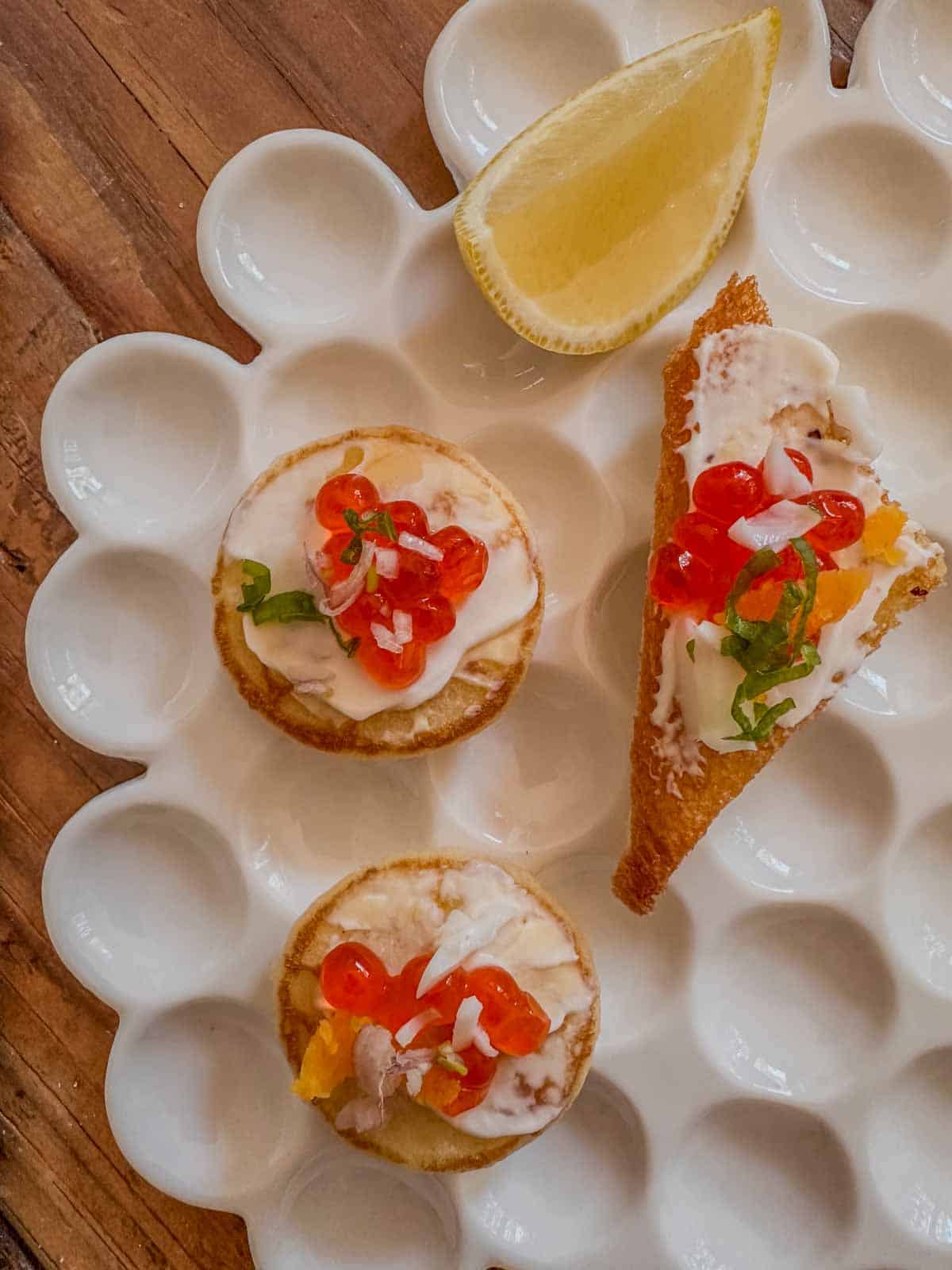
A white plate topped with caviar appetizers including blinis and a toast point topped with creme fraiche, cavair, green onions, and shallots and a lemon wedge.

I used to think that caviar was only for special occasions or for the wealthy and entirely pretentious.

You see those glossy pearls in the tin and wonder if you're supposed to do something special with them, or if eating them wrong will somehow waste the entire experience.

The truth is, caviar is one of the most misunderstood ingredients in the kitchen, and you can enjoy caviar without any special rituals and without spending a fortune.

Caviar is briny, buttery, and tastes deeply of the ocean in a way that no other ingredient does. It has a texture and flavor that doesn't need much to shine.

In fact, the best ways to enjoy fish eggs are pretty simple, so please read on for some easy ideas and different ways on how to serve and enjoy caviar!

Jump to:
  • A Bit Of Background On Caviar
  • 🍽 Equipment
  • 🥘 Ingredients
  • 🔪 Instructions
  • Suggestions For Serving
  • FAQ
  • 1,000 Foods To Eat Project
  • Some Other Foods That You Will Enjoy!
  • Join Me On A Fun Food Journey!
  • Easy Caviar Appetizers Recipe

A Bit Of Background On Caviar

Caviar's reputation as the ultimate luxury ingredient comes from centuries of Persian and Russian tradition, where sturgeon roe was harvested from the Caspian Sea.

In Russia, caviar was enjoyed by both peasants and nobility because of the abundance of sturgeon in the rivers of Russia.

Over time, Beluga caviar became associated with the opulence of the Russian tsars, who treated it as a luxury ingredient and was used to display the wealth of the aristocracy. At court it was served with ceremony and ritual, often accompanied by cold vodka or champagne at Russian tables.

Eventually caviar spread to Western Europe and was adopted especially in France as a symbol of wealth, as in Russia.

In France caviar became a part of haute cuisine, and the French approach to caviar was more refined and elegant as compared to the Russian style, which was more hearty and abundant.

Today we carry on the traditions of the Russians and the French in some of the following ways:

  • Keeping the caviar nestled in ice to keep it chilled
  • Using mother of pearl spoons, as metallic spoons were thought to react with the caviar and change its delicate flavor
  • Serving with toast points, blinis, crème fraîche, and garnishes such as hard boiled egg and shallots that are finely chopped
  • Pairing with chilled vodka and champagne

Here I'm going to carry on these traditions in a a simple and unfussy way, which will make caviar much more approachable.

🍽 Equipment

You don't really need a specialty caviar service set, but a few special pieces of equipment will enhance your experience.

  • A non metallic spoon - a metal spoon will react with caviar and can change the clean taste of the roe. Use a mother-of-pearl spoon if you have one, or you could use a small plastic or wooden spoon as well
  • Something to keep the caviar chilled - caviar should be served chilled because at room temperature it loses its flavor and texture quickly. A small ice bowl or a shallow dish set over a larger bowl of ice is an excellent option and a great way to keep the caviar cold without needing to constantly refrigerate it between servings. I purchased an inexpensive caviar chiller server set (which also comes with mother of pearl spoons) which worked really well for me.
A hand holding a glass with ice and a metal tin with caviar.
My makeshift caviar serving set
The bottom of a caviar serving dish filled with ice topped with the top portion containing caviar and a mother of pearl spoon.
Caviar serving set with mother of pearl spoon
  • Small board or serving tray to put garnishes and accompaniments such as blinis and toast points on is recommended
  • Sharp knife and cutting board for prepping garnishes

As you can see, there are no expensive crystal serving sets listed here!

🥘 Ingredients

Here are the ingredients you'll need for an exquisitely simple caviar appetizer experience:

The Caviar

  • Caviar - the star of the show. Start with 1 to 2 ounces per person as an appetizer. Sturgeon caviar is the classic choice, but for a more affordable price consider American domestic caviars such as salmon roe, hackleback roe, and paddlefish roe. The roe I enjoyed was from Paramount Caviar, which also offers more premium caviar. Store caviar in the coldest part of your fridge (often at the back of your bottom shelf) and open the tin just before serving to preserve freshness.
A person's hand holding the top of a Salmon Caviar tin next to the rest of the tin filled with Salmon Caviar.

The Bases

  • Blinis or toast points - these provide the base for the caviar. Blinis are small, yeasted buckwheat pancakes with a slightly tangy flavor that pairs beautifully with roe. I used Marky's Cocktail Blinis which you can buy online. You may also be able to find blinis at a well stocked grocery store, specialty shops or make your own. Toast points are thin slices of bread, lightly buttered, toasted and cut into triangles. I made my own toast points which are super easy to make and you can find many recipes on the internet for them.
A package of Marky's Blinis.
Blinis
A baking tray topped with toast points.
Toast points

The Garnishes

  • Crème fraîche or sour cream - these add a wonderfully creamy and tangy element that balances the salty taste of the roe. Crème fraîche (a classic pairing for caviar) is richer and thicker, which makes it a more refined choice, but sour cream works just as well. These should be full fat and spread thinly on your blini or toast point. Low fat or nonfat is definitely not recommended!
  • Butter is highly recommended! Use a high-quality butter at room temperature so it spreads easily on toast points and blinis. A good option is Kerrygold Grass Fed butter which is rich, creamy, and utterly indulgent. Again, you'll want to spread this thinly on your caviar vehicle (blini or toast point).
  • Hard-boiled eggs are a traditional garnish that adds richness. Separate the yolk and white, then finely chop each one individually. The yolk adds creaminess, while the white provides a clean, slightly firm texture.
  • Green onions (green part only) or chives, shallots, and lemon provide a bit of brightness and sharpness. Chives are more traditional than green onion, but you can sub the green part only of green onions if you like. Finely minced green onion or chives add a mild onion flavor, while finely diced shallots (could also sub red onion) bring a bit more bite. Use these sparingly, and add a squeeze of lemon just prior to eating the caviar for a little acidity.
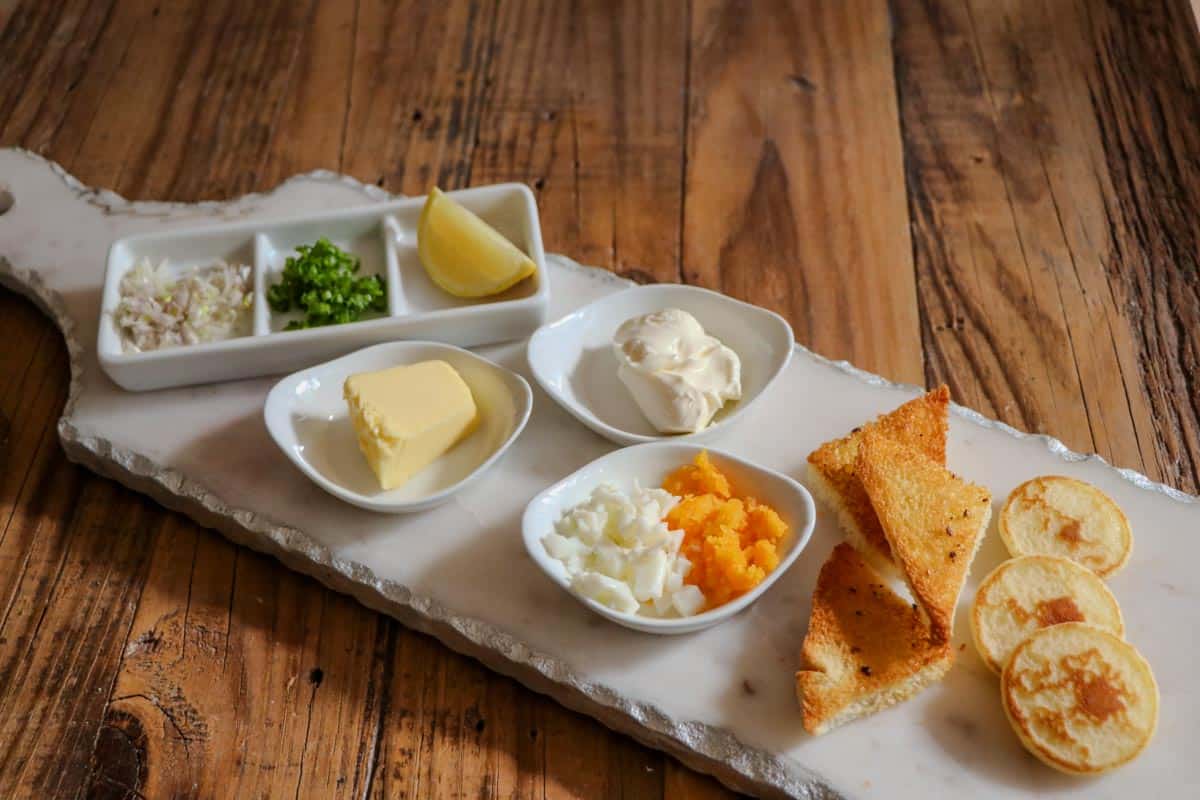
a serving plate with caviar toppings including lemon wedge, green onions, shallots, creme fraiche, chopped egg, toast points and blinis.

🔪 Instructions

Prepare Your Bases

Allow your butter to come to room temperature. Toast points should also be served at room temperature. If using refrigerated blinis, allow them to come to room temperature as well.

NOTE ABOUT THE BLINIS: Typically they are warmed before serving, however I find this a bit fiddly and opt to serve these at room temperature. If you want to warm them, the best way is to gently warm them in a dry skillet for a few seconds just prior to serving.

For a simple recipe for toast points, slice white bread into triangles, brush lightly with melted butter, and toast in a 400-degree oven for 6-8 minutes or until golden and crisp.

Prep The Garnishes

Prep the garnishes. Finely mince green onion (or chives), and shallots. Finely chop the egg yolks and egg whites after separating them. Cut some lemon wedges and prepare small dishes with creme fraiche (or sour cream) and butter.

Place your garnishes and the bases (blinis and toast points) on your serving tray.

Prepare Your Caviar Chiller

Prepare your caviar chiller or small bowl with ice. If using the caviar chiller, fill with crushed ice, then use your non metallic spoon to place some caviar in the top portion of the caviar chiller. a small ice bowl or a shallow dish set over a larger bowl of ice will also work.

💭 Top tip

Caviar loses its texture and flavor quickly at room temperature, so keeping it chilled throughout service is an absolute must.

Assembly Time!

Start with your base, and spread a thin layer of butter followed by a thin layer of crème fraiche on the top of the blini or toast point.

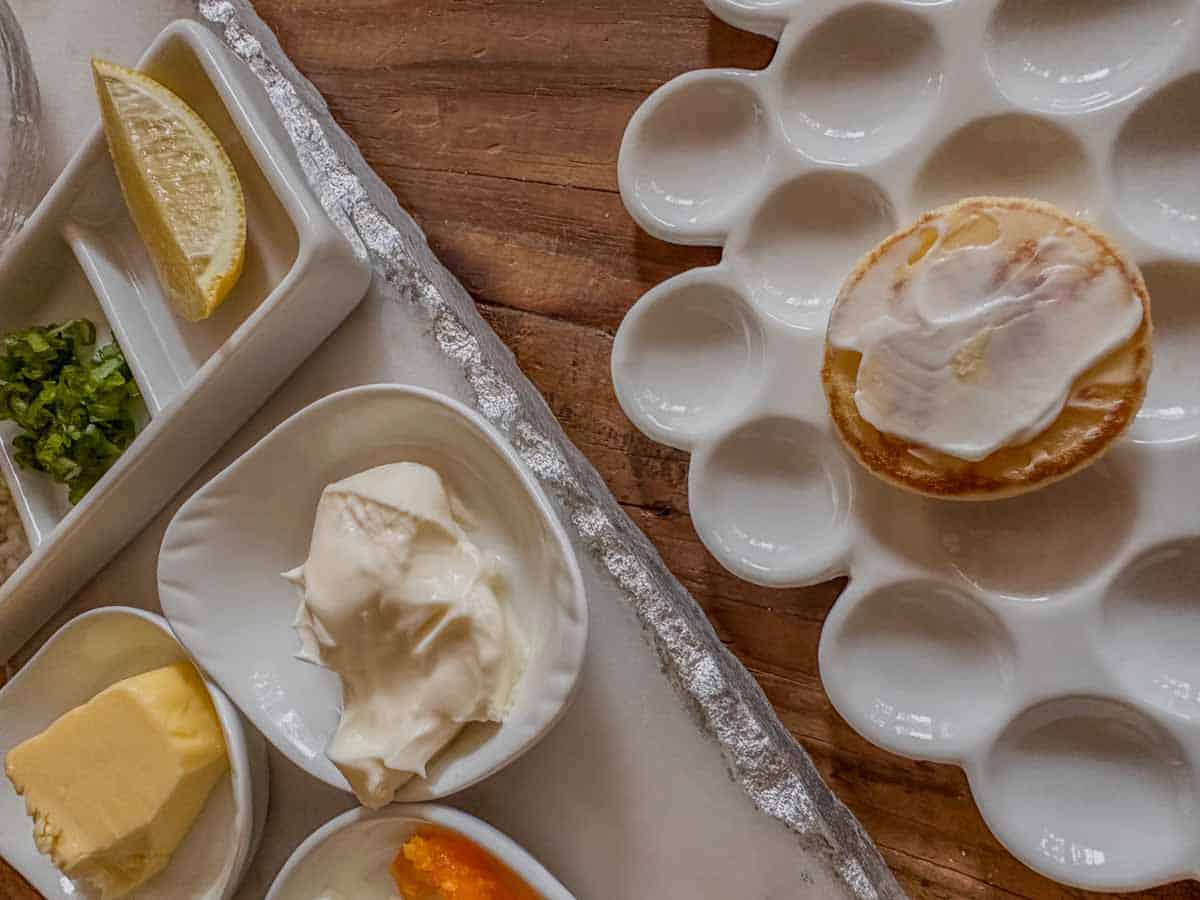
A white plate with dimples topped with a blini with creme fraiche, next to a serving tray with butter, creme fraiche, lemon, green onions, and chopped hard boiled egg.

Top with caviar. Use a non-metallic spoon to gently scoop a small amount of caviar from your caviar tin, and place it directly on top of the creamy base.

A white plate topped with a caviar appetizer a blini topped with creme fraiche and salmon caviar next to a serving tray with a glimpse of creme fraiche.

Add your garnishes sparingly. Add your choice of hard-boiled egg, green onions, chives, or shallots, sprinkle a small pinch over the caviar. Squeeze a tiny bit of lemon juice over the top if you like.

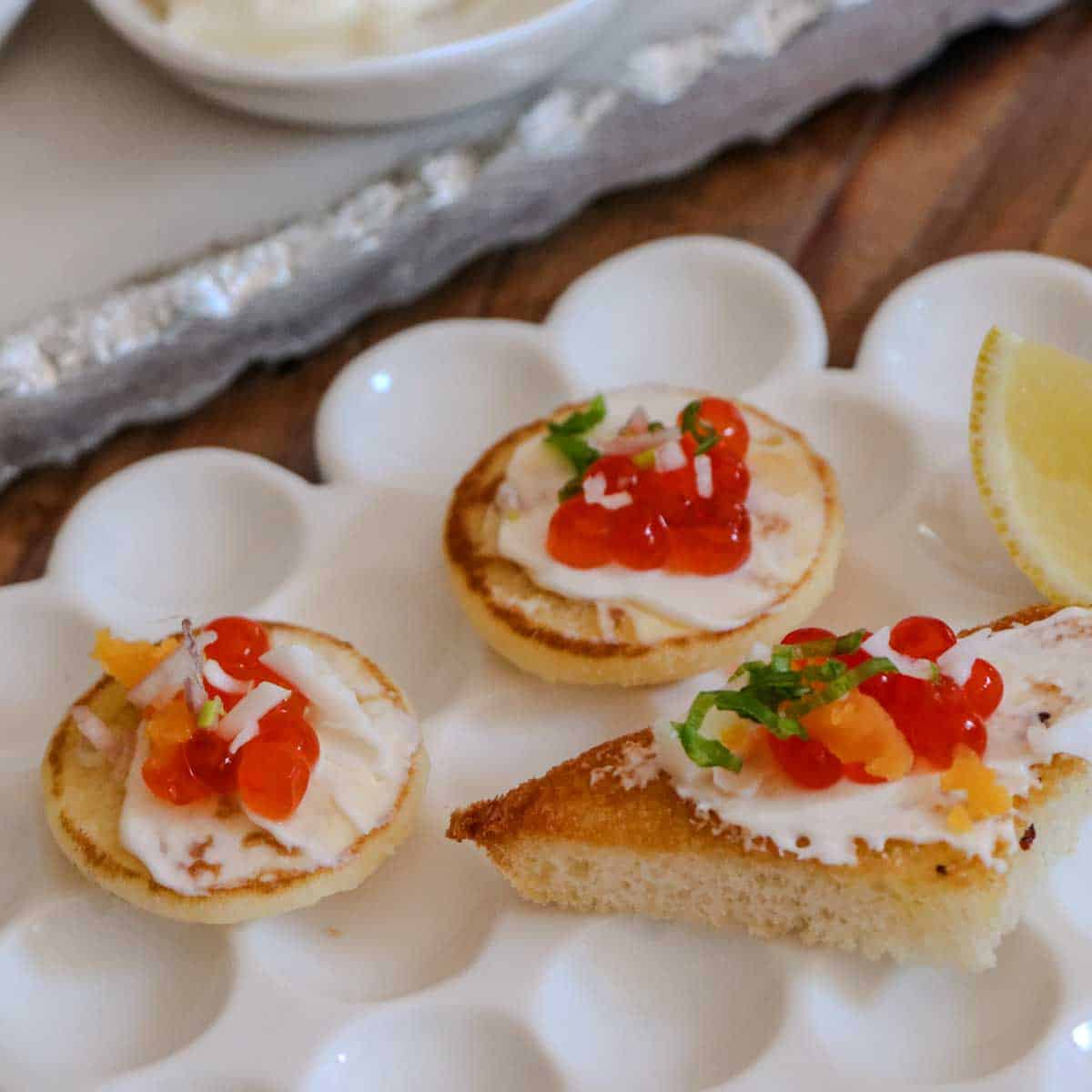
A white plate topped with caviar appetizers including blinis and a toast point topped with creme fraiche, caviar, green onions, and shallots and a lemon wedge, with a part of another serving platter in the background.

Your caviar appetizers are now ready to enjoy!

Suggestions For Serving

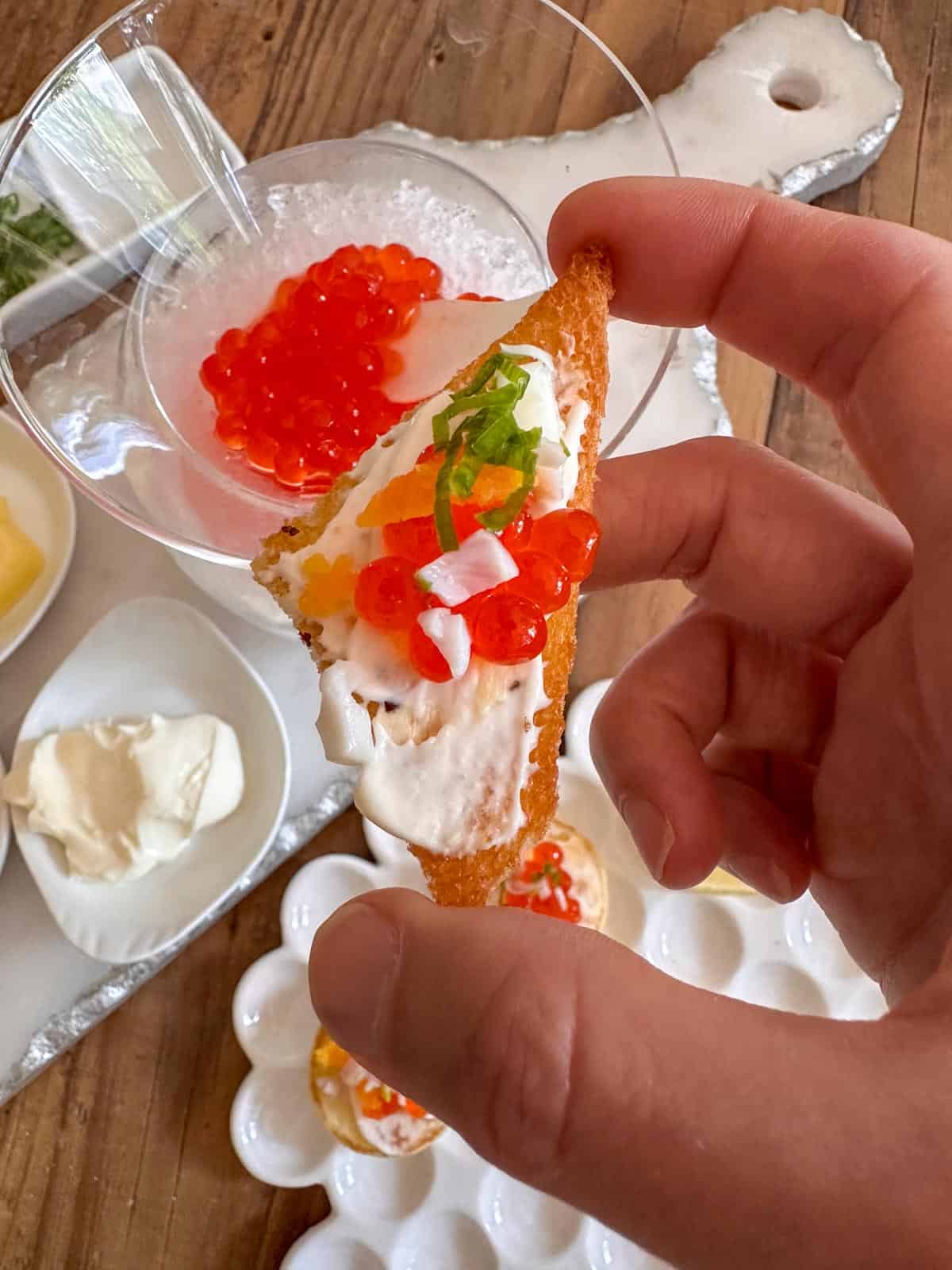
A hand holding a toast point caviar appetizer over a serving tray with a caviar filled caviar serving dish and a bowl of creme fraiche, and another plate with more caviar appetizers.

You'll want to serve your appetizers immediately. Fish roe is best eaten within minutes of plating, while it's still cold and the base hasn't softened too much.

My bet is you will love the accompanying beverage suggestions for your delicious appetizer.

Caviar pairs beautifully with some iced vodka (a classic Russian pairing). Pour it straight from the freezer into chilled shot glasses and sip it slowly, letting the cold liquid mingle with the salty pearls.

The classic French pairing is a bottle of champagne. Look for brut or extra brut styles (dry or extra dry) and avoid sweet champagnes or sparkling wines for the best experience.

For food pairings, it's best to keep it simple. Some thinly sliced smoked salmon, oysters on the half shell, or a light cucumber salad would all pair well with your gourmet treat.

The best caviar appetizers are the ones where the caviar is the thing you remember most, and not the garnishes.

Keep it cold, keep it simple, and let those gloriously glossy pearls do what they do best!

Enjoy each and every sumptuous briny bite of your luxurious delicacy! Your taste buds will be delighted!

FAQ

What are some affordable options for caviar?

Fine caviar can be outrageously expensive! But there are some more affordable options. Consider American domestic caviars such as salmon roe, hackleback roe, and paddlefish roe. These are available at a less expensive price point than premium caviars but are still outrageously delicious! My caviar came from Paramount Caviar, which offers a great selection of both expensive caviar and more affordable ones.

What are blinis?

Blinis are small, yeasted buckwheat pancakes with a slightly tangy flavor that are a classic caviar pairing. You can make your own or find them at a premium grocer or online.

Do I need a special caviar chiller to serve caviar?

You do need something to keep the caviar chilled - caviar should be served chilled because at room temperature it loses its flavor and texture quickly. A caviar chiller set definitely makes things easier when serving caviar. However, in lieu of one, a small ice bowl or a shallow dish set over a larger bowl of ice will work.

1,000 Foods To Eat Project

The classic combination of Blini With Caviar is listed in the book 1,000 Foods To Eat Before You Die, by Mimi Sheraton. I am working my way through the foods listed in this book. This is called my 1,000 Foods to Eat Project. Caviar blinis is food #87 in my project! Please visit the 1,000 Foods To Eat Project page to see some other MUST TRY foods of the world that you may love to try!

Some Other Foods That You Will Enjoy!

Here are some other foods that you will enjoy!

  • Super Easy Texas Caviar Recipe With Shoepeg Corn - ok so I'm just playing off the name here. Hope you might find this somewhat amusing!
  • Easy Homemade Salted Chicken Egg Yolks - use this umami filled ingredient to top any leftover blini you may have!
  • Delicious Russian Ground Chicken Cutlet - if you're interested in exploring Russian foods further, try this delicious chicken dish!

Join Me On A Fun Food Journey!

I invite you to come along on this food journey with me! Please sign up to get the latest recipes and inspiration for you to expand your food horizons! It's an incredible journey, please join me by signing up here.

Cheers!

Grace

A white plate topped with caviar appetizers including blinis and a toast point topped with creme fraiche, caviar, green onions, and shallots and a lemon wedge, with a part of another serving platter in the background.

Easy Caviar Appetizers Recipe

GRACE STEWART
Serving caviar doesn't have to be pretentious! Try this easy caviar appetizers recipe and enjoy caviar without the fuss!
5 from 1 vote
Print Recipe Pin Recipe
Prep Time 20 minutes mins
Total Time 20 minutes mins
Course Appetizer
Cuisine American
Servings 2 people
Calories 131 kcal

Equipment

  • non metallic spoon Use a mother-of-pearl spoon if you have one, or you could use a small plastic or wooden spoon as well
  • caviar chiller server set could also use a small ice bowl or a shallow dish set over a larger bowl of crushed ice; many caviar chiller server sets also come with mother of pearl spoons!
  • small board or serving tray for garnishes and accompaniments
  • sharp knife and cutting board for prepping garnishes

Ingredients
  

  • 2 oz caviar recommend 1 oz per person
  • 10 each blinis use store bought or make your own
  • 10 each toast points slice white bread into triangles, brush lightly with melted butter, and toast in a 400-degree oven for 6-8 minutes or until golden and crisp. Let them cool completely before serving.
  • 1 tablespoon Crème fraîche can sub sour cream
  • 1 tablespoon butter serve at room temperature; Kerrygold Grass Fed Butter is highly recommended
  • 1 hard boiled egg Separate the yolk and white, then finely chop each one individually.
  • 1 ts green onion mince the green part only or finely mince some chives
  • 1 ts shallots minced; could sub red onion
  • 2 each lemon wedges
InstacartGet Recipe Ingredients

Instructions
 

  • Allow your butter to come to room temperature. Toast points should also be served at room temperature. If using refrigerated blinis, allow them to come to room temperature as well. NOTE ABOUT THE BLINIS: Typically they are warmed before serving, however I find this a bit fiddly and opt to serve these at room temperature. If you want to warm them, gently warm them in a dry skillet for a few seconds just prior to serving.
  • To make toast points, slice white bread into triangles, brush lightly with melted butter, and toast in a 400-degree oven for 6-8 minutes or until golden and crisp.
  • Prep the garnishes. Finely mince green onion (or chives), and shallots. Finely chop the egg yolk and whites after separating them. Cut some lemon wedges and prepare small dishes with crème fraîche (or sour cream) and butter.
  • Place your garnishes and the bases (blinis and toast points) on your serving tray.
  • Prepare your caviar chiller or small bowl with ice. If using the caviar chiller, fill with crushed ice, then use your non metallic spoon to place some caviar in the top portion of the caviar chiller. A small ice bowl or a shallow dish set over a larger bowl of ice will also work.
  • Caviar loses its texture and flavor quickly at room temperature, so keeping it chilled throughout service is an absolute must.
  • Now it's time to assemble! Start with your base, and spread a thin layer of butter followed by a thin layer of crème fraîche on your blini/toast point.
  • Top with caviar. Use a non-metallic spoon to gently scoop a small amount of caviar, and place it directly on top of the creamy base.
  • Add your garnishes sparingly. Add your choice of hard-boiled egg, green onions, chives, or shallots, sprinkle a small pinch over the caviar. Add a tiny squeeze of lemon juice over the top if you like.
  • Enjoy immediately! Caviar is best eaten right after assembling. Just be sure to fully immerse yourself in each delightful bite!

Notes

Please note:  the nutritional information unfortunately doesn't include info on the blinis and toast points.  I apologize for any inconvenience this may cause.

Nutrition

Calories: 131kcalCarbohydrates: 2gProtein: 11gFat: 9gSaturated Fat: 3gPolyunsaturated Fat: 2gMonounsaturated Fat: 2gCholesterol: 261mgSodium: 472mgPotassium: 97mgFiber: 0.1gSugar: 1gVitamin A: 404IUVitamin C: 1mgCalcium: 100mgIron: 4mg
Keyword caviar
Tried this recipe?Let us know how it was!

Crispy Deep Fried Artichoke: Roman Jewish Recipe

July 30, 2026 by Grace 1 Comment

Want to know the BEST way to enjoy an artichoke? It's the Roman Jewish way! Carciofi alla giudia, Roman-Jewish deep-fried artichokes, are easy to make and will become your new favorite totally addictive snack, perfect appetizer, or side dish!
A pair of tongs holding a fried artichoke over a deep fat fryer filled with oil.
Jump to:
  • What is Carciofi Alla Giudia?
  • 🥘 Ingredients
  • 🔪 Instructions
  • Suggestions For Serving
  • FAQ
  • Some Other Recipes You Will Enjoy!
  • Join Me On A Fun Food Journey!
  • Fried Artichoke Recipe: Crispy Roman Perfection

What is Carciofi Alla Giudia?

Carciofi alla giudia translates to "Jewish-style artichokes," and the dish has been a cornerstone of Roman Jewish cuisine since the 16th century. It originated in the Jewish Ghetto of Rome, and is one of the best known dishes in Roman Jewish cuisine.

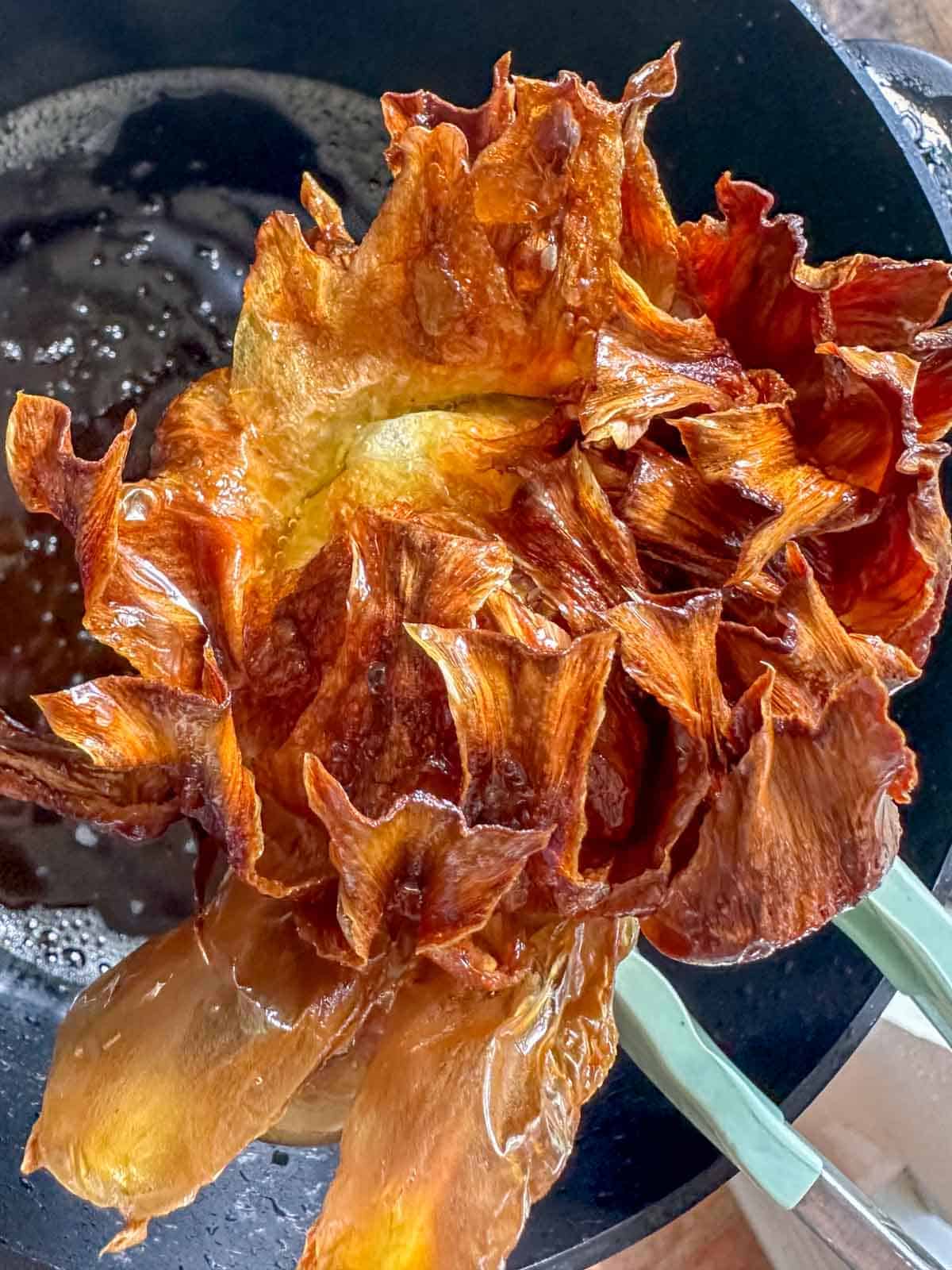
This iconic recipe features a double-fry method. The first fry gently cooks the artichoke so that it softens, becomes tender, and the outer leaves start to brown and bloom.

The second fry happens at a higher temperature and does two things: it forces the tightly packed leaves to open and fan out, and it crisps every exposed surface until it shatters. The result is a dish that's equal parts vegetable and chip, with layers of texture that range from aggressively crunchy to melt-in-your-mouth tender. It's a masterclass in how temperature control and patience can completely transform an ingredient.

Intrigued? Please read on to find out what ingredients you will need to make this incredible dish!

🥘 Ingredients

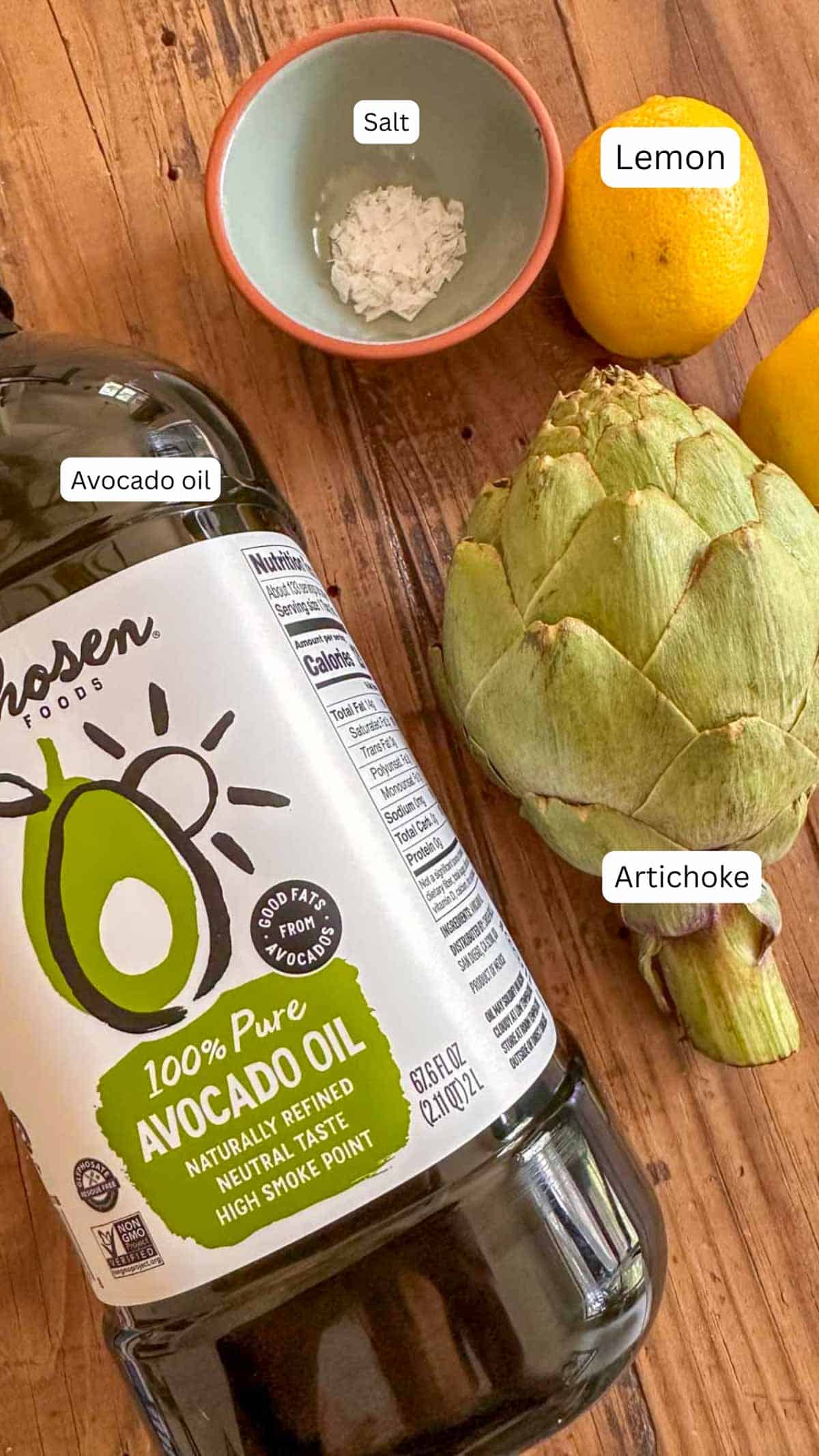
Fresh artichoke, lemon, avocado oil, salt in a bowl for cooking.

You only need 4 simple ingredients to make these shatteringly crispy artichokes:

  • Fresh artichokes - I used a fresh globe artichoke; these are the type commonly found in supermarkets in the United States where I am based - select an artichoke that feels heavy for its size and has tightly packed leaves
  • Avocado oil - olive oil is the more traditional oil to use, but I love avocado oil for deep frying (it has a high smoke point, although we don't require that in this recipe); you could also use vegetable oil
  • Sea salt - I used both flaky sea salt and regular sea salt as seasonings to be sprinkled on after frying
  • Lemon - lemons will be used as both seasoning and as an agent to help prevent the avocado from oxidizing

🔪 Instructions

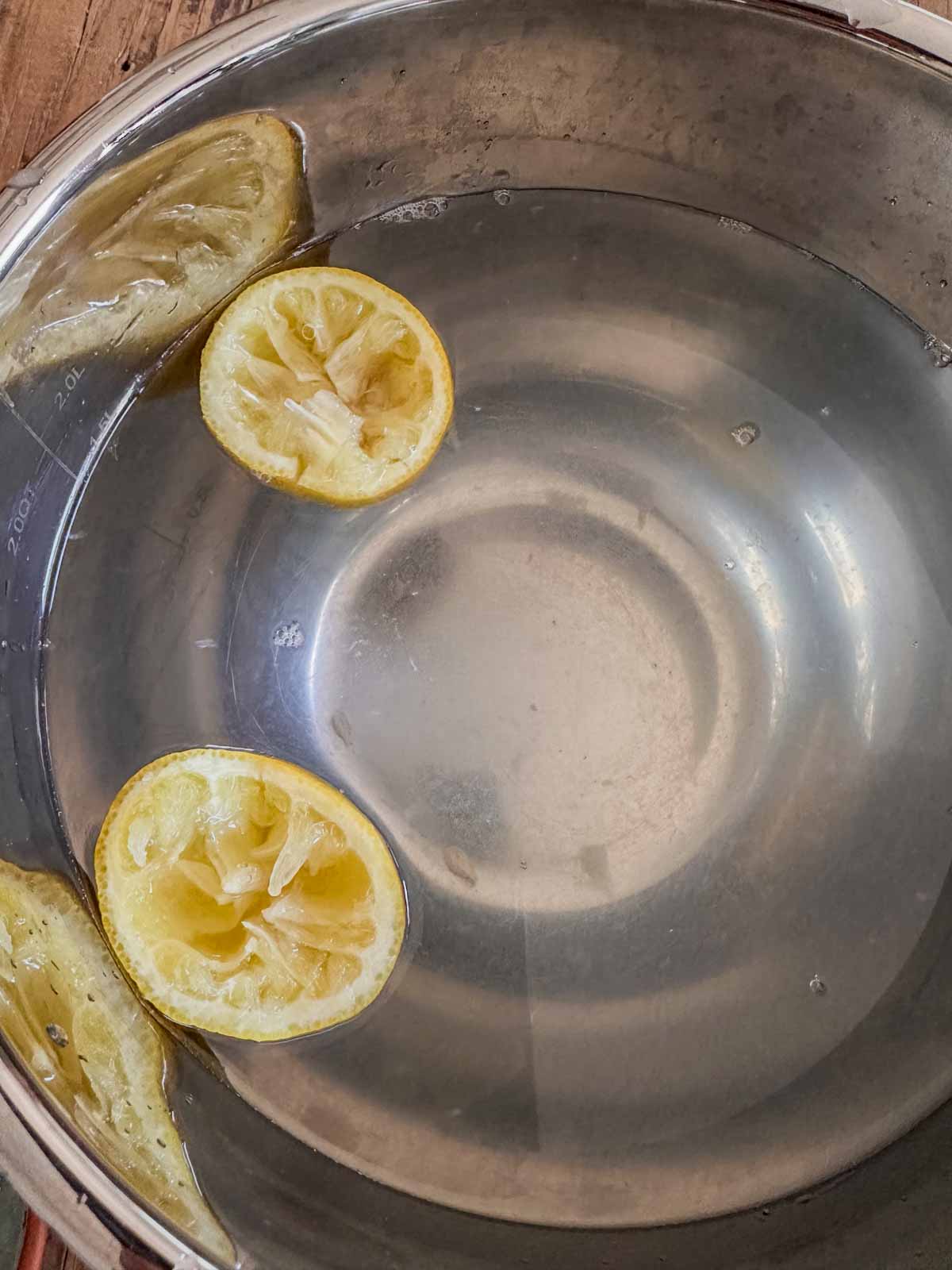
Prepare your lemon water bath by filling a medium sized bowl with some cold water. Squeeze in the juice of one of the lemons, then add the lemon halves (once squeezed) to the water as well.

PLEASE NOTE: you want just enough water to submerge the artichoke and not so much water that the lemon juice is very diluted.

A bowl containing lemon water and two lemon halves.

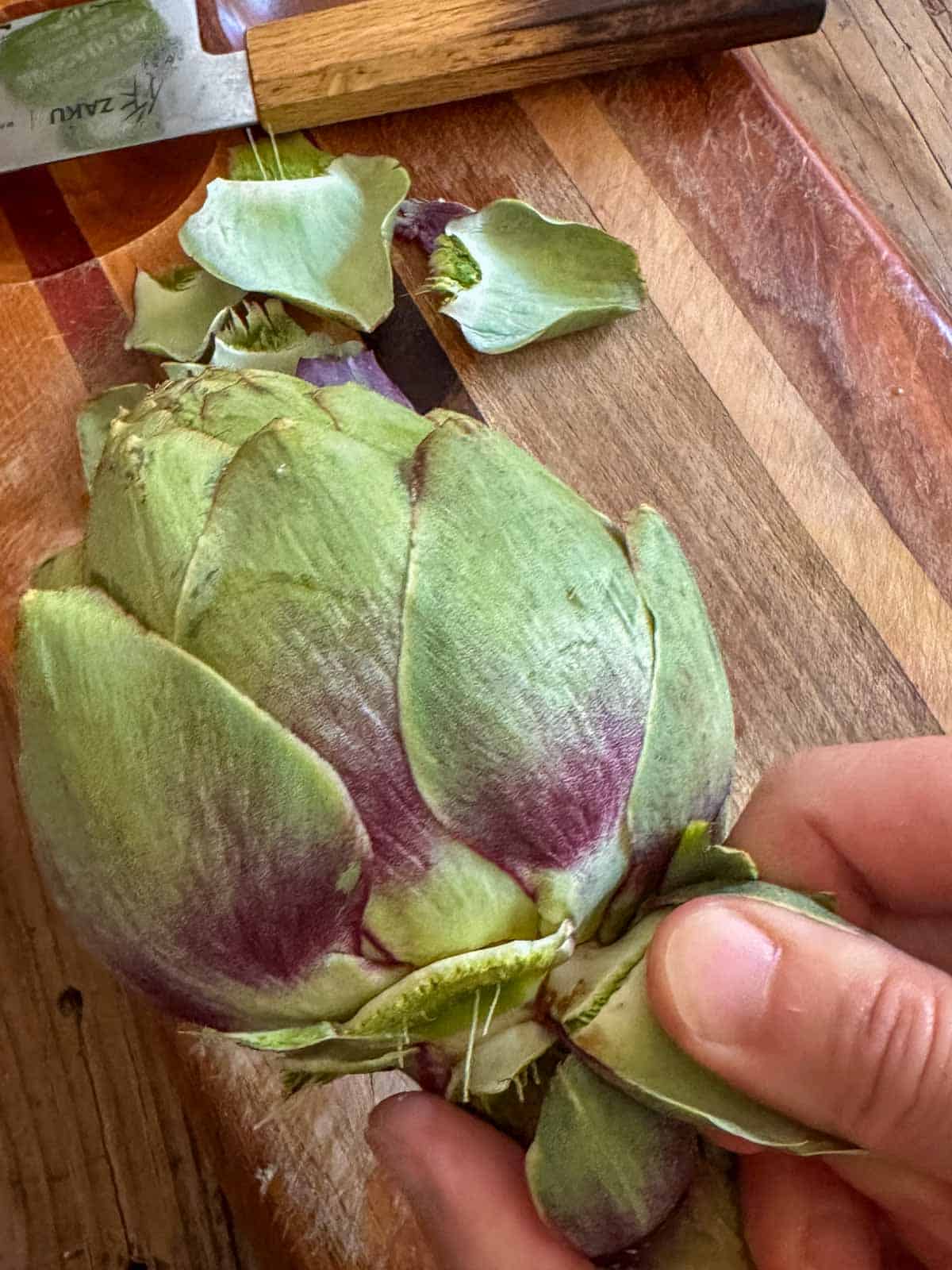
Trim your artichokes by peeling away the tough outer leaves until you reach the more tender yellow/green leaves underneath, then you want to use a knife to remove as much of the green part as you can, leaving mostly only the tender yellow part of the artichoke.

A person's hand being used to peel off the outer leaves of an artichoke with some of the peeled artichoke leaves and a knife in the background.

Use a sharp knife to trim the stem (leave about 2 -3 inches attached), then use a vegetable peeler or sharp paring knife to remove the fibrous outer layer of the stem.

A person holding an artichoke and using a knife to cut off part of the stem with a half lemon in the background.
A person using a vegetable peeler to peel off the outer stem of an artichoke over a bowl which contains outer leaves of the artichoke which has been peeled, with a knife and lemon in the background.

The green outer part of the stem is fibrous. Remove that part to leave the pale tender part of the stem, as well as any hard green leaves with a sharp knife.

A hand holding an artichoke upside down featuring the stem which has been cut and shows the pale tender part and the darker green fibrous part.
A hand holding an artichoke that is partially trimmed with a knife in the background.
A hand holding a trimmed artichoke upside down also featuring part of the stem's fibrous part also having been trimmed.

If you see any spiky tips left, be sure to slice off that part of the artichoke to remove them.

A person holding an artichoke and using a knife to cut off part of the top with a half lemon in the background.
A person holding an artichoke with the top cut off and a knife and vegetable peeler in the background.

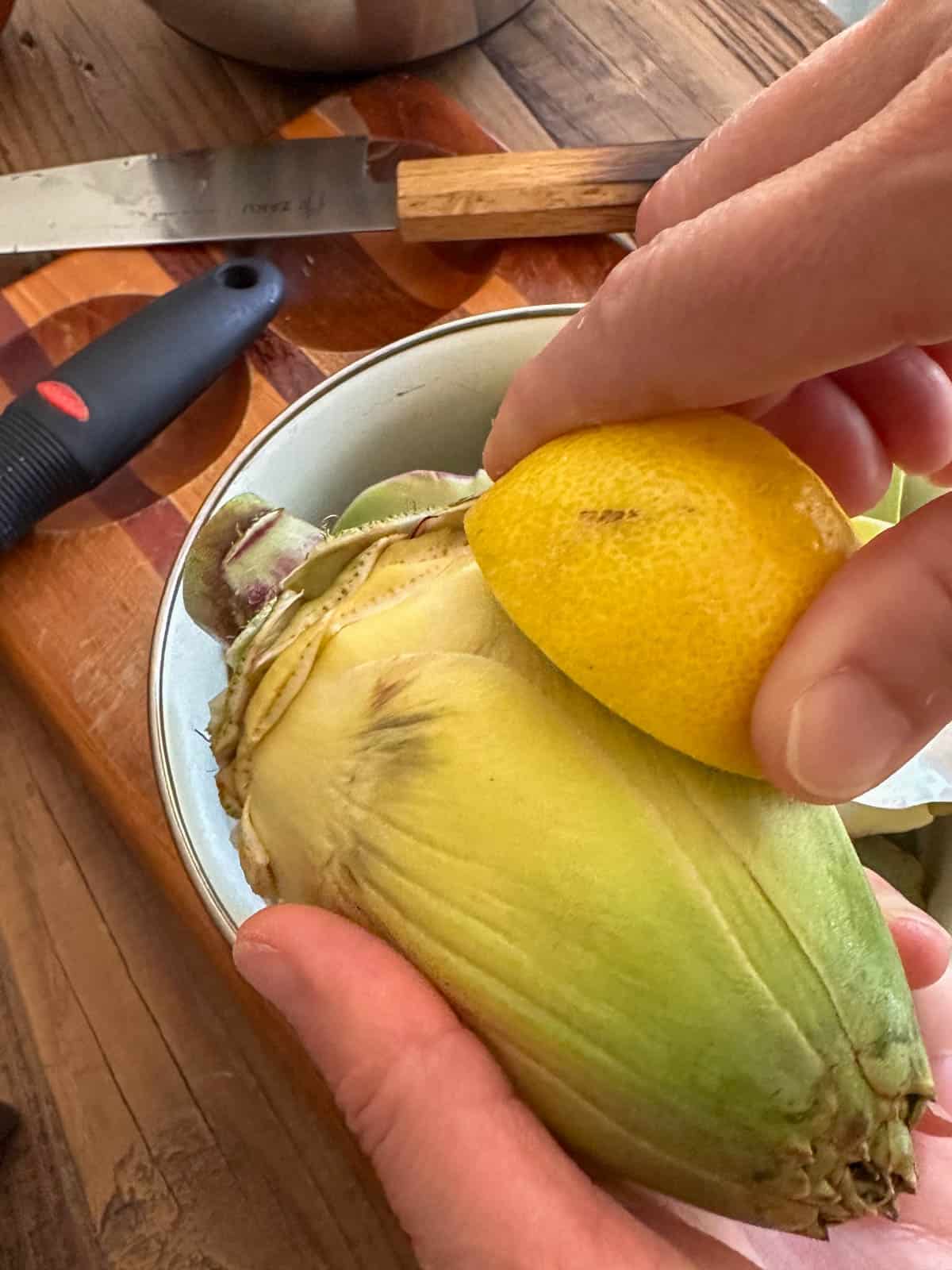
As you work, use one of the other lemon halves to rub over the artichoke to help prevent oxidation which turns the leaves brown to black. The artichoke starts to oxidize quickly, so be sure to work fast!

A person rubbing an artichoke with a lemon and a knife and peeler in the background.

💭 Top tip

Be ruthless with your trimming! It may seem that you are "wasting" a lot of the artichoke leaves, but believe me you don't want the green leaves they will be tough and unpleasant to eat. Also, don't forget to rub the artichoke with the lemon to prevent oxidation.

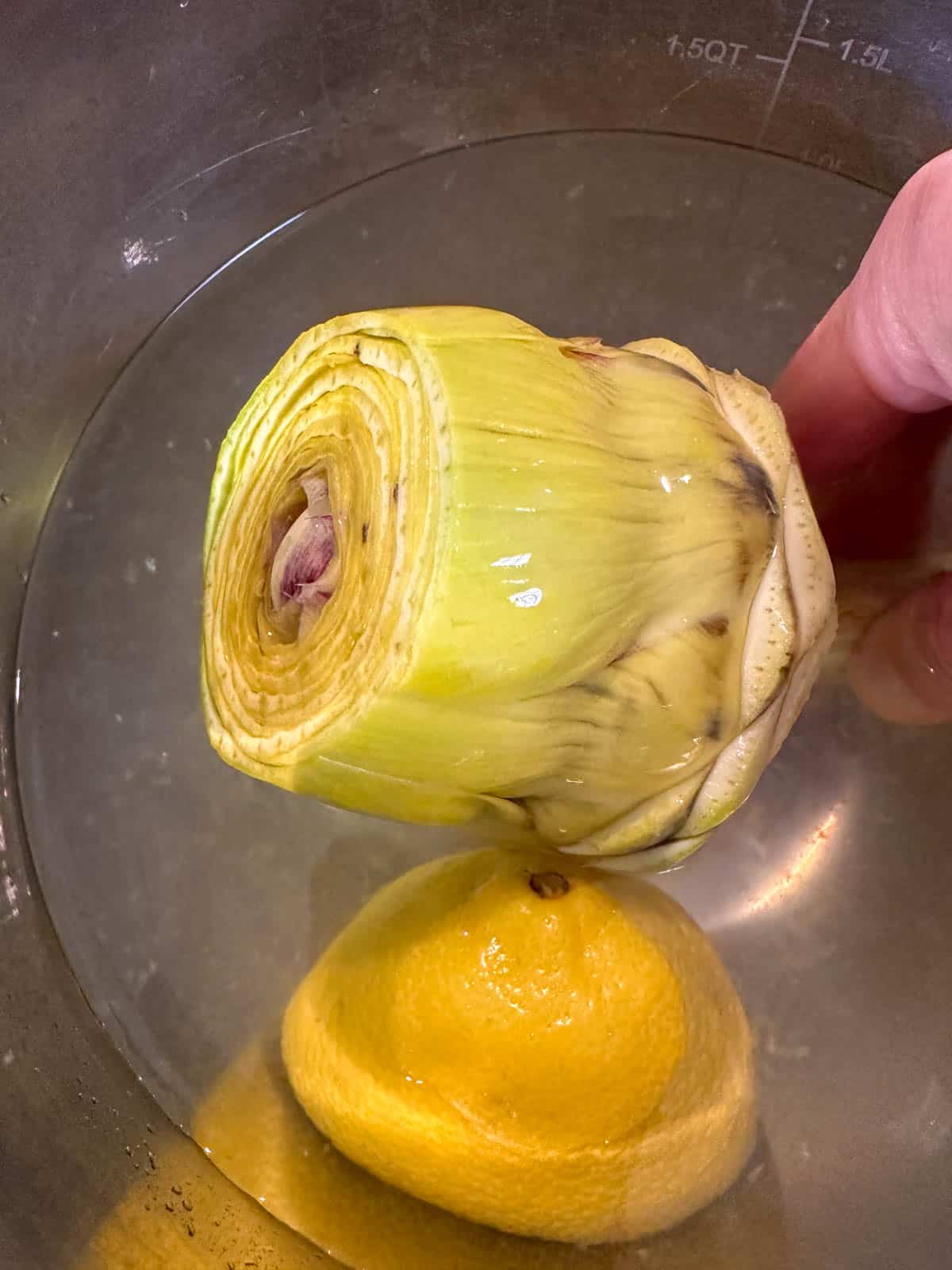
Now that your artichoke is prepped, add it to the lemon water bath.

A prepped artichoke and lemon half in a lemon water bath.

1st Fry

Heat the oil in your deep fryer to 250F (this is the 1st fry to make the artichoke tender).

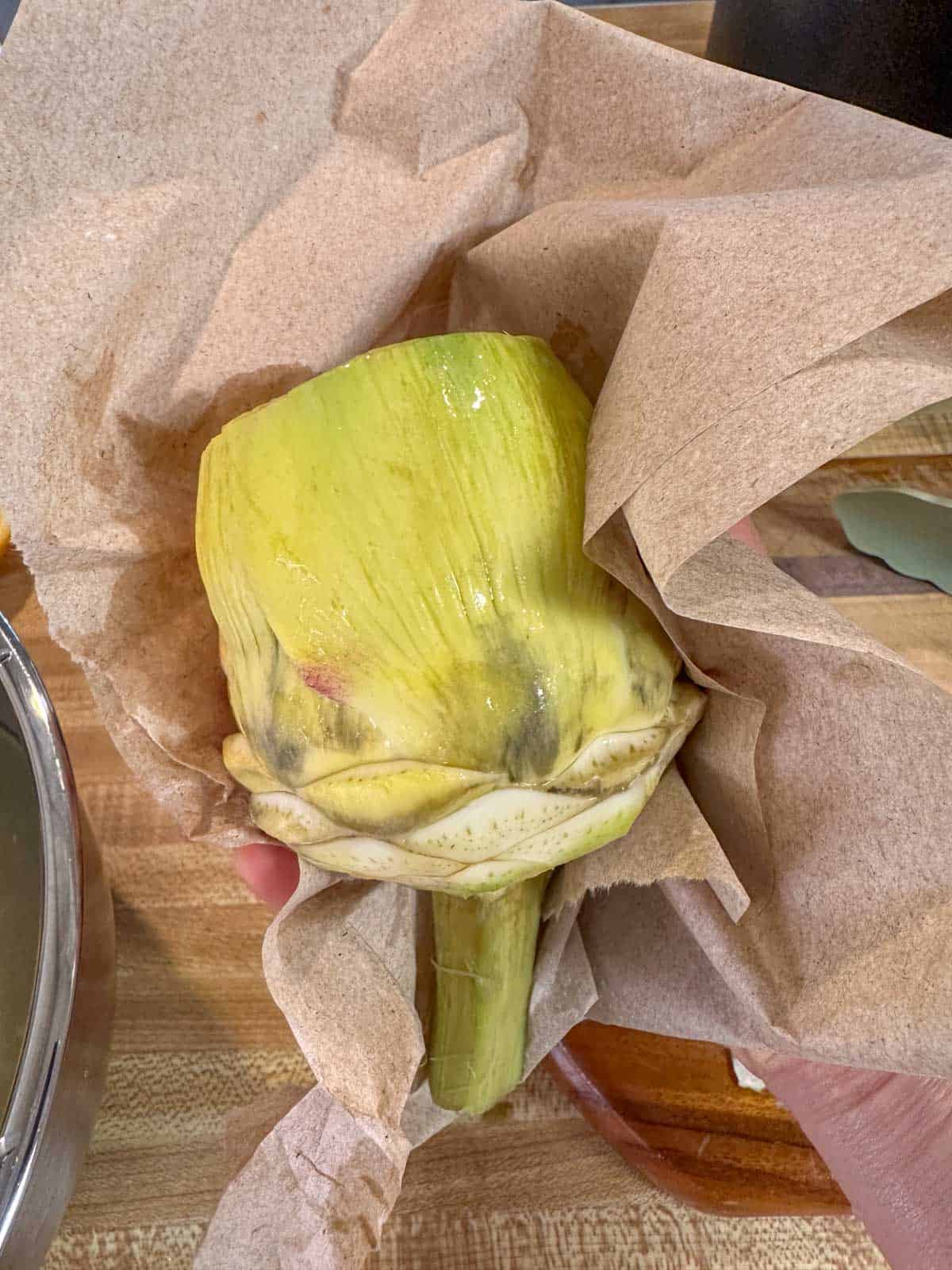
Once the oil reaches this temperature, remove the artichoke from your lemon water bath and dry the artichoke removing excess moisture as completely as you can using paper towels.

Be sure to press down on it with the stem to the top which will also help to get rid of excess water inside the artichoke.

A prepped artichoke being dried in a paper towel.

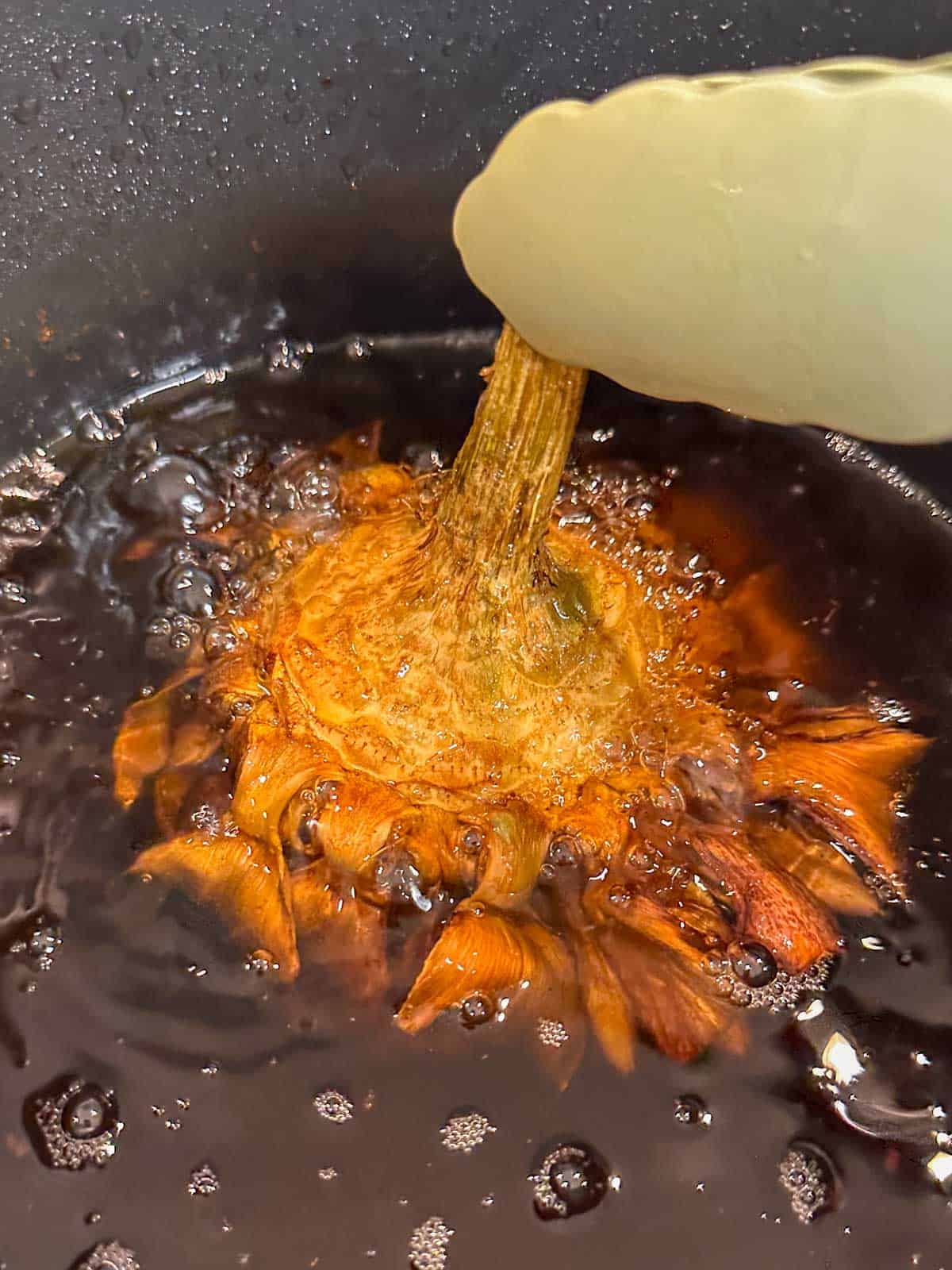
Lower the dried artichoke into the hot oil using a set of tongs. Fry the artichoke low and slow for about 15 minutes, turning the artichoke frequently using the tongs for even frying and best results.

During this time you should see the leaves start to brown.

An artichoke held by tongs being fried in hot oil in a fryer, with the leaves opening like petals.
An artichoke being fried in hot oil in a deep fryer.

PLEASE NOTE: Your artichoke doesn't have to be completely submerged under the oil, but be sure to turn it frequently so that it fries evenly.

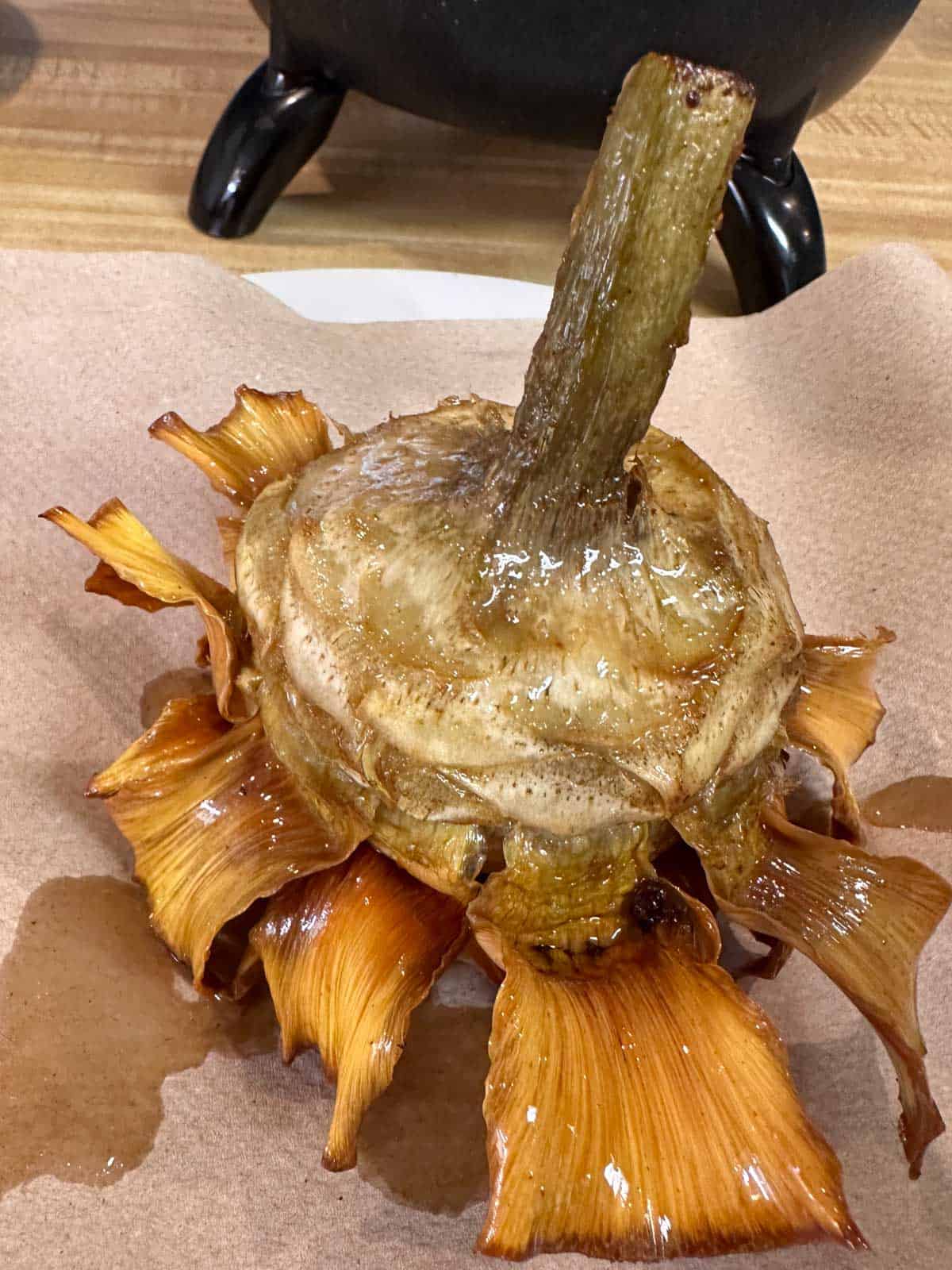
After 15 minutes, remove the artichoke using the tongs and place upside down (stem is facing up) on paper towels or a wire rack, allowing the artichoke to drain and rest for about 10 minutes.

An upside down fried artichoke draining on a paper towel.

2nd Fry And Removing The Choke

During this time, raise the oil temperature to 350F for your 2nd fry which will crisp up the artichoke.

Gently use your hands (once the artichoke is cool) to pry open the leaves. At this point, use a spoon to scoop out the hairy and inedible choke.

This reveals the artichoke heart.

Two gloved hands holding a partially fried artichoke ready to pry the leaves open.
A gloved hand holding an artichoke and the person's other hand holding a teaspoon ready to scoop out the choke.
A gloved hand holding a fried artichoke whose petals have been pulled back to reveal the heart with a teaspoon in the background.

Prying open the leaves will also encourage the artichoke to bloom!

Carefully lower the artichoke back into the hotter oil using your tongs, and allow to fry and crisp for about 3 minutes or so, turning a few times or holding it under the oil for even coloring.

A pair of tongs holding an artichoke upside down frying in hot oil in a deep fryer.

Remove the crispy artichoke from the hot oil and drain upside down on some fresh paper towels.

Suggestions For Serving

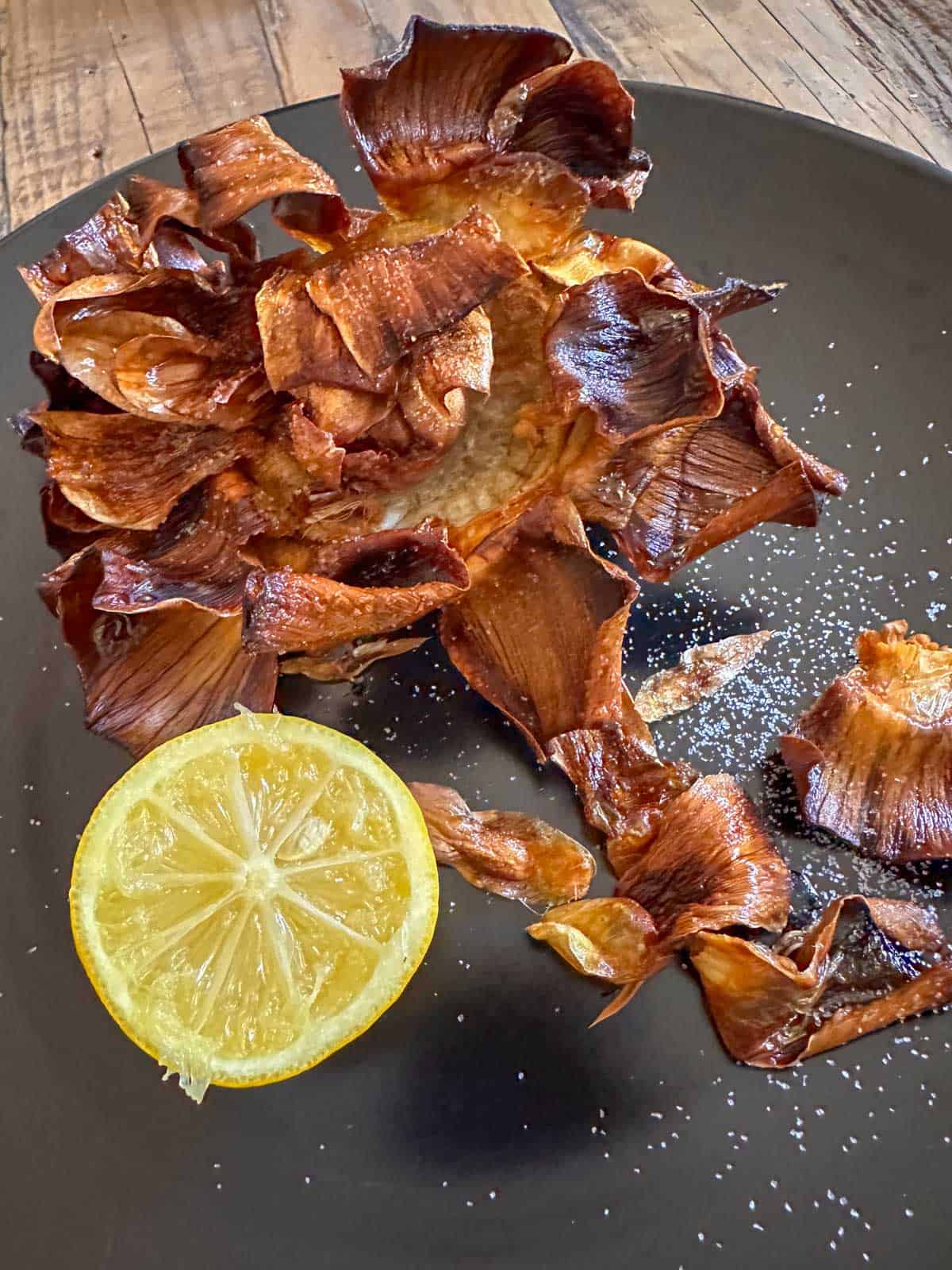
A black plate containing a crispy fried artichoke that has been salted and half a lemon.

Season immediately with some sea salt and a generous squeeze of lemon juice from lemon wedges, and enjoy while hot!

Remove a petal and savor each golden shatteringly crispy bite! Be sure to enjoy the delicious stem and tender heart as well!

Enjoy these as a snack, or perhaps serve these as an easy appetizer alongside some marinated olives, or thinly sliced prosciutto.

Carciofi alla giudia also pairs well with a simple arugula salad dressed with lemon and good olive oil. The peppery greens and acid balance the fried richness without competing for attention.

An Italian white wine such as Pinot Grigio or an Italian Negroni cocktail would be the perfect drink accompaniment.

I hope this will become one of your favorite artichoke recipes!

Please see below for a printable recipe card!

Buon appetito!

FAQ

How should I serve Italian Fried Artichoke?

Serve fried artichokes the Italian way, with simply seasoning with salt and squeezing lemon juice over it. That's all you need!

Why are some of the leaves still hard and chewy (and not crispy) after frying an artichoke?

Most likely these leaves should have been removed during the prepping process. During prep, any leaves with dark green color should be ruthlessly discarded, leaving only pale colored leaves for frying. It could also be that the oil during the 2nd fry was not hot enough.

Some Other Recipes You Will Enjoy!

Love Italian food? Then you'll want to try these recipes:

  • Italian Broccoli Recipe With Garlic and Lemon
  • Easy and Elegant White Asparagus Side Dish Recipe
  • Italian Peas and Ham Frozen Peas Recipe

Join Me On A Fun Food Journey!

I invite you to come along on this food journey with me! Please sign up to get the latest recipes and inspiration for you to expand your food horizons! It's an incredible journey, please join me by signing up here.

Cheers!

Grace

A black plate containing a crispy fried artichoke that has been salted and half a lemon.

Fried Artichoke Recipe: Crispy Roman Perfection

GRACE STEWART
I am convinced that one of the BEST ways to enjoy an artichoke is to fry it the Italian way! Try this Deep Fried Artichoke recipe and experience crispy Roman perfection today!
5 from 1 vote
Print Recipe Pin Recipe
Prep Time 10 minutes mins
Cook Time 18 minutes mins
Total Time 28 minutes mins
Course Appetizer
Cuisine Italian
Servings 2 people
Calories 6171 kcal

Equipment

  • 1 Deep Fat Fryer you can also use a heavy-bottomed pot or Dutch oven but a deep fat fryer makes frying so much easier
  • deep fry or candy thermometer you'll need this if you aren't using a deep fat fryer
  • pair of tongs
  • Medium bowl
  • sharp knife
  • sharp paring knife to remove the fibrous part of the stem and any remaining hard green leaves at the base of the artichoke
  • paper towels or wire rack for draining the artichoke of oil

Ingredients
  

  • 1 artichoke I used a large globe artichoke with stem attached
  • 2 lemons 1 will be used for lemon water bath, ½ for rubbing the artichoke, and ½ for serving
  • 1.5 liter frying oil olive oil is most traditional, but I used avocado oil with great results; you could also sub vegetable oil
  • sea salt or flaky sea salt (or both) for seasoning
InstacartGet Recipe Ingredients

Instructions
 

  • Prepare your lemon water bath by filling a medium sized bowl with some cold water. Squeeze in the juice of one of the lemons, then add the lemon halves (once squeezed) to the water as well. PLEASE NOTE: you want just enough water to submerge the artichoke and not so much water that the lemon juice is very diluted.
  • Don't use so much water that the lemon juice is super diluted - aim for a good acidulated lemon water bath!
  • Trim your artichokes by peeling away the tough outer leaves until you reach the more tender yellow/green leaves underneath, then you want to use a knife to remove as much of the green part as you can, leaving mostly only the tender yellow part of the artichoke. Use a sharp knife to trim the stem (leave about 2 -3 inches attached), then use a sharp paring knife to remove the fibrous outer layer of the stem. If you see any spiky tips left, be sure to slice off that part of the artichoke to remove them. As you work, use one of the other lemon halves to rub over the artichoke to help prevent oxidation which turns the leaves brown to black. The artichoke starts to oxidize quickly, so be sure to work fast!
  • Be ruthless with your trimming! It may seem that you are "wasting" a lot of the artichoke leaves, but believe me you don't want the green leaves they will be tough and unpleasant to eat. Also, don't forget to rub the artichoke with the lemon to prevent oxidation.
  • Now that your artichoke is prepped, add it to the lemon water bath.
  • Heat the oil in your deep fat fryer to 250F (this is the 1st fry to make the artichoke tender). Once the oil reaches this temperature, remove the artichoke from your lemon water bath and dry the artichoke as completely as you can using paper towels. Be sure to press down on it with the stem to the top which will also help to get rid of excess water inside the artichoke. Lower the dried artichoke into the hot oil using a set of tongs. Fry the artichoke low and slow for about 15 minutes, turning the artichoke frequently using the tongs for even frying and best results. During this time you should see the leaves start to brown.
  • Your artichoke doesn't have to be completely submerged under the oil, but be sure to turn it frequently so that it fries evenly.
  • After 15 minutes, remove the artichoke using the tongs and place upside down (stem is facing up) on paper towels or a wire rack, allowing the artichoke to drain and rest for about 10 minutes.
  • During this time, raise the temperature of the oil to 350F for your 2nd fry which will crisp up the artichoke. Gently use your hands (once the artichoke is cool) to pry open the leaves. At this point, use a spoon to scoop out the hairy and inedible choke. Carefully lower the artichoke back into the hotter oil using your tongs, and allow to fry and crisp for about 3 minutes or so, turning a few times or holding under the oil for even coloring.
  • Don't forget to gently pry open the leaves and remove the hairy choke prior to your 2nd fry! I have left the choke in before, and the results are not good. Leaving it in doesn't allow the inner leaves to crisp up so be sure to get it out of there!
  • Remove the crispy artichoke from the hot oil and drain upside down on some fresh paper towels. Season immediately with some sea salt and a generous squeeze of lemon juice from lemon wedges, and enjoy while hot! Be sure to enjoy the delicious stem and tender heart as well!

Notes

Hello!  Please note that this online nutrition calculator includes the 1.5 liters of frying oil in its calculations.  Of course you won't be consuming that much frying oil so please bear that in mind when reviewing the nutrition facts.  Please accept my apologies for any inconvenience and thanks for your understanding!

Nutrition

Calories: 6171kcalCarbohydrates: 17gProtein: 3gFat: 691gSaturated Fat: 105gPolyunsaturated Fat: 396gMonounsaturated Fat: 157gTrans Fat: 5gSodium: 62mgPotassium: 386mgFiber: 6gSugar: 3gVitamin A: 32IUVitamin C: 65mgCalcium: 56mgIron: 2mg
Keyword artichoke, fried artichoke, Roman food
Tried this recipe?Let us know how it was!

Awesome Authentic Pub-Worthy Ploughman's Lunch Recipe For Real Cravings!

June 29, 2026 by Grace 3 Comments

Your lunch break just got a major upgrade! This Ploughman's Lunch Recipe takes just a few minutes to assemble and hits every craving you didn't know you had until now!

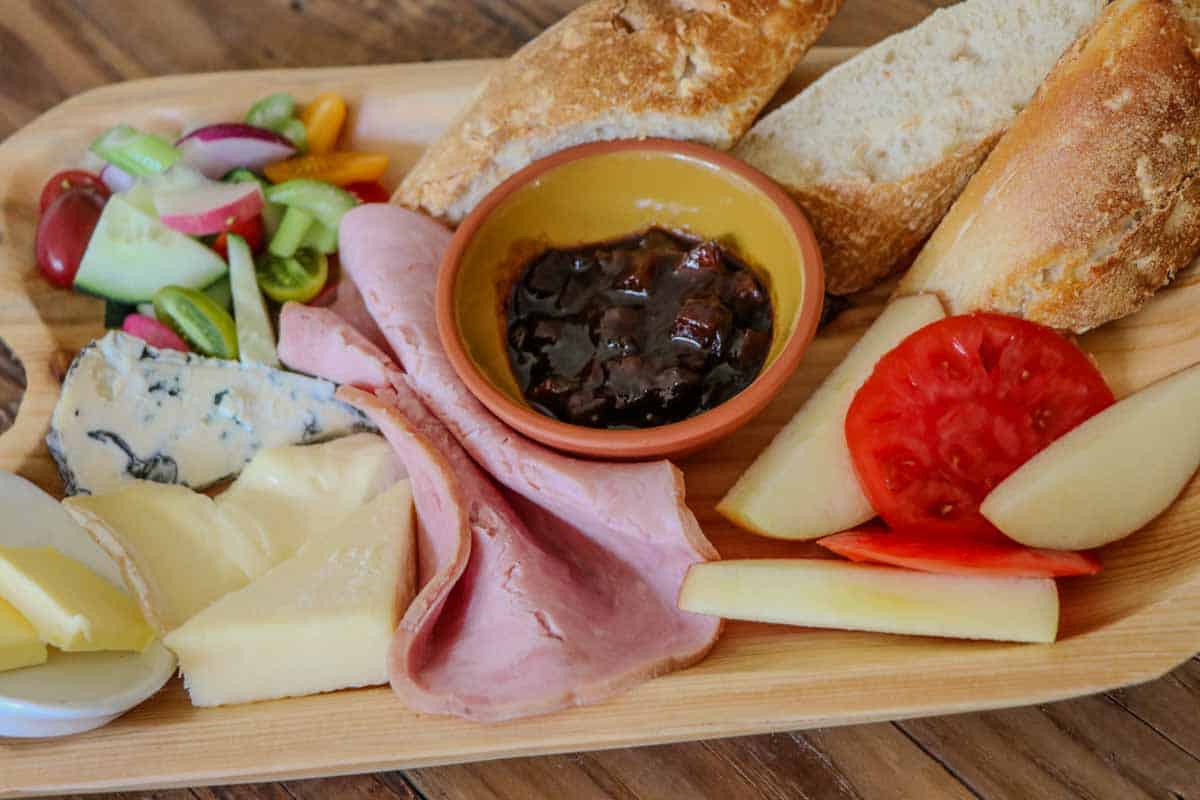
Ploughman's lunch displayed on a wooden platter including cheeses, ham, butter, vegetables, pieces of bread, Branston pickle in a bowl, sliced tomato and apple.

Some lunches just hit different.

That's where the Ploughman's lunch comes in. It's a British pub staple that's basically a curated cheese board with serious staying power, with ham, mature cheddar, and all the tangy, crunchy, savory things that make cold lunches actually exciting.

It's deceptively simple but wildly satisfying. There's a reason this combo has been fueling pub-goers in Britain for decades.

It was my favorite meal on my recent trip to visit family in England. This version is based on the Ham and Cheese Saracen's Ploughman's that I had at the Saracen's Head in Highworth, England.

This Ploughman's Lunch recipe will show you how to build an awesome, authentic pub-worthy Ploughman's Lunch that will satisfy all your cravings!

Jump to:
  • The History Of The Ploughman's Lunch
  • 🥘 Ingredients
  • 🔪 Instructions
  • Suggestions For Your Ploughman's Experience
  • FAQ
  • Some Other British Recipes You Will Enjoy!
  • Join Me On A Fun Food Journey!
  • Awesome Authentic Pub-Worthy Ploughman's Lunch Recipe For Real Cravings!

The History Of The Ploughman's Lunch

The Ploughman's lunch sounds ancient and pastoral, and the main ingredients (bread and cheese) are indeed ancient.

However the name "Ploughman's lunch" and its association with pubs is actually surprisingly modern.

The term "Ploughman's lunch" was popularized in the 1950s by the British Cheese Bureau as a brilliant marketing push to sell more cheese in pubs. But the combination of the Ploughman's itself (bread, cheese, pickles, and cold meat), has roots going back centuries as a working-class meal.

Farmhands and rural laborers needed lunches that didn't require cooking, and were cheap and portable. Cheese and bread were pantry staples. Pickles and chutneys added preservation, and cold cuts made it into a filling meal.

By the 1970s, the Ploughman's rose in popularity and was a pub menu fixture across the UK.

This pub stable became a customizable plate that varied by region, but typically maintain a balance of salty, sharp, tangy, and is always filling.

It's proof that the best food doesn't need to be cooked. I will prove it to you here!

🥘 Ingredients

So, I'm going to show you what I used to create my Ploughman's, but feel free to customize yours to suit your tastes.

The Cheese

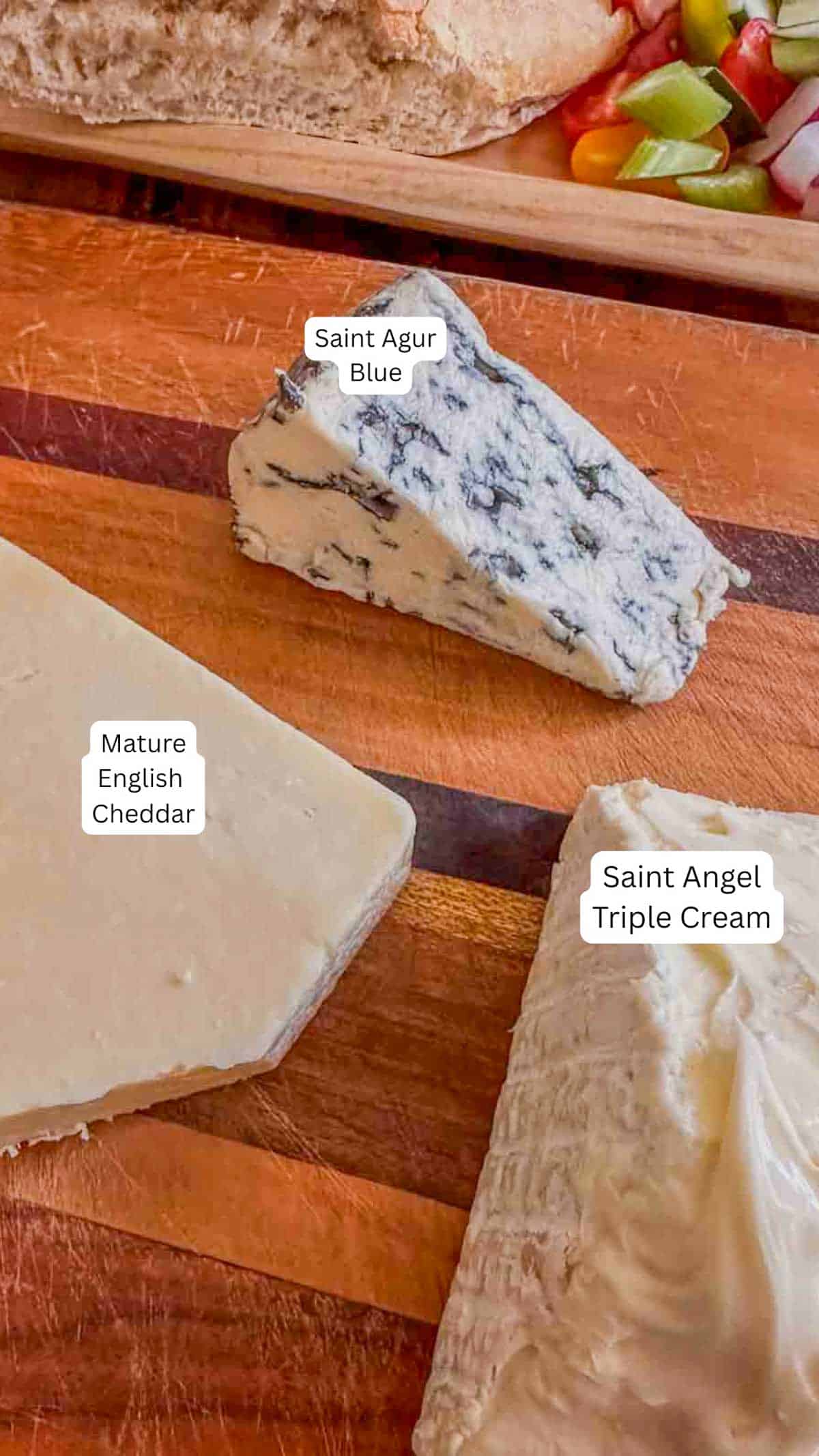
Cheddar, blue cheese, and triple cream cheese on a wooden cutting board, and bread and vegetables in the background.

I bought the following cheeses for my Ploughman's:

  • Mature English Cheddar - I consider this an ABSOLUTE MUST for your Ploughman's! 😄Of course it is ok to choose your favorite cheddar, but I beg of you to buy a block of cheddar, and not sliced! You could also substitute with aged Gruyère or a firm English cheese like Red Leicester.
  • Saint Agur Blue - to be honest, I wanted an English Blue Stilton, but it wasn't available at the store I was at so bought this delicious French blue cheese from the Auvergne region instead. If you can find English Blue Stilton, I highly recommend it for your homemade British pub lunch!
  • Saint Angel Triple Cream Brie - here's another French cheese that is completely decadent and worth a place in your Ploughman's! It has a buttery taste will spread beautifully on your crusty bread!

In short, I recommend a cheddar (hopefully you'll select an English Mature one 😄), a blue cheese, and a brie or perhaps a camembert. Go with these, or choose your favorites.

Three different cheeses will give you a nice variety of tastes and textures for your platter.

By the way, you want to use blocks of cheese...no sliced cheese allowed. 😄

💭 Top tip

For best results, allow your cheeses to come to room temperature. Cold cheese is harder to taste and doesn't release its full flavor. Pull the cheeses out of the fridge 20 minutes before assembling. They will be creamier, more aromatic, and the cheddar will be easier to break into chunks.

Fresh Veggies And Fruit

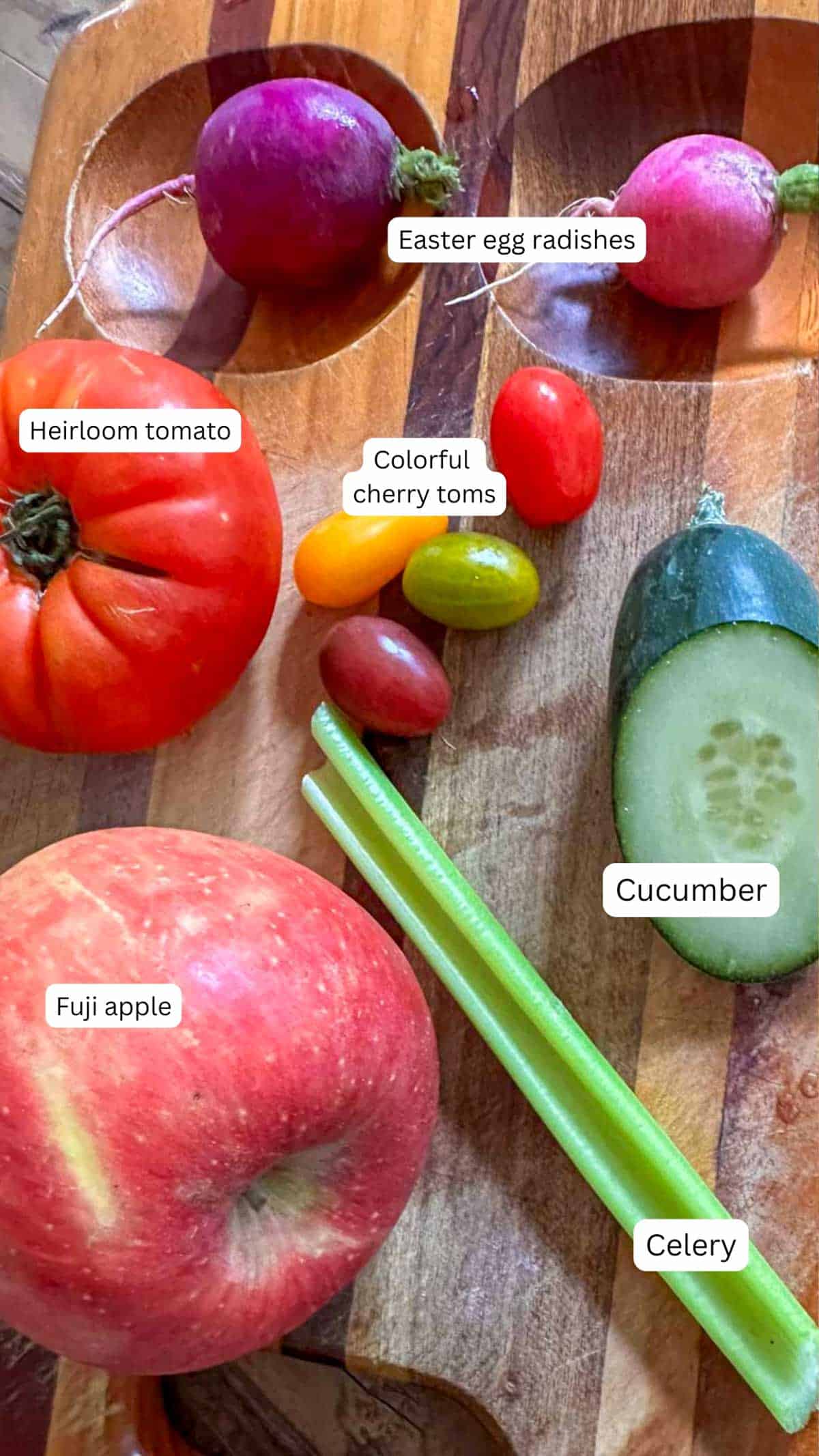
A wooden cutting board displaying an assortment of vegetables including a tomato, cherry tomatoes, celery, cucumber, radishes, and an apple.

Fresh vegetables and fruit add crunch and freshness. They're not just garnish. They're palate cleansers that keep the plate from feeling too heavy, and add so much color to your lunch plate!

Here's what I bought for my platter:

  • Celery
  • Radishes - if you can find Easter egg radishes do yourself a favor and get those! They are so beautiful and colorful!
  • Cucumber
  • Cherry tomatoes - I got the colorful medley Wild Wonders tomatoes - the more color, the better!
  • Large tomato (I selected an Heirloom tomato) - you'll cut these into slices
  • Apple - (I used Fuji apple) - this will add a bit of sweetness to your Ploughman's

These are all great choices to include, but by all means substitute your favorite fresh veggies and fruit to create your perfect homemade pub fare!

The Pickle (Chutney)

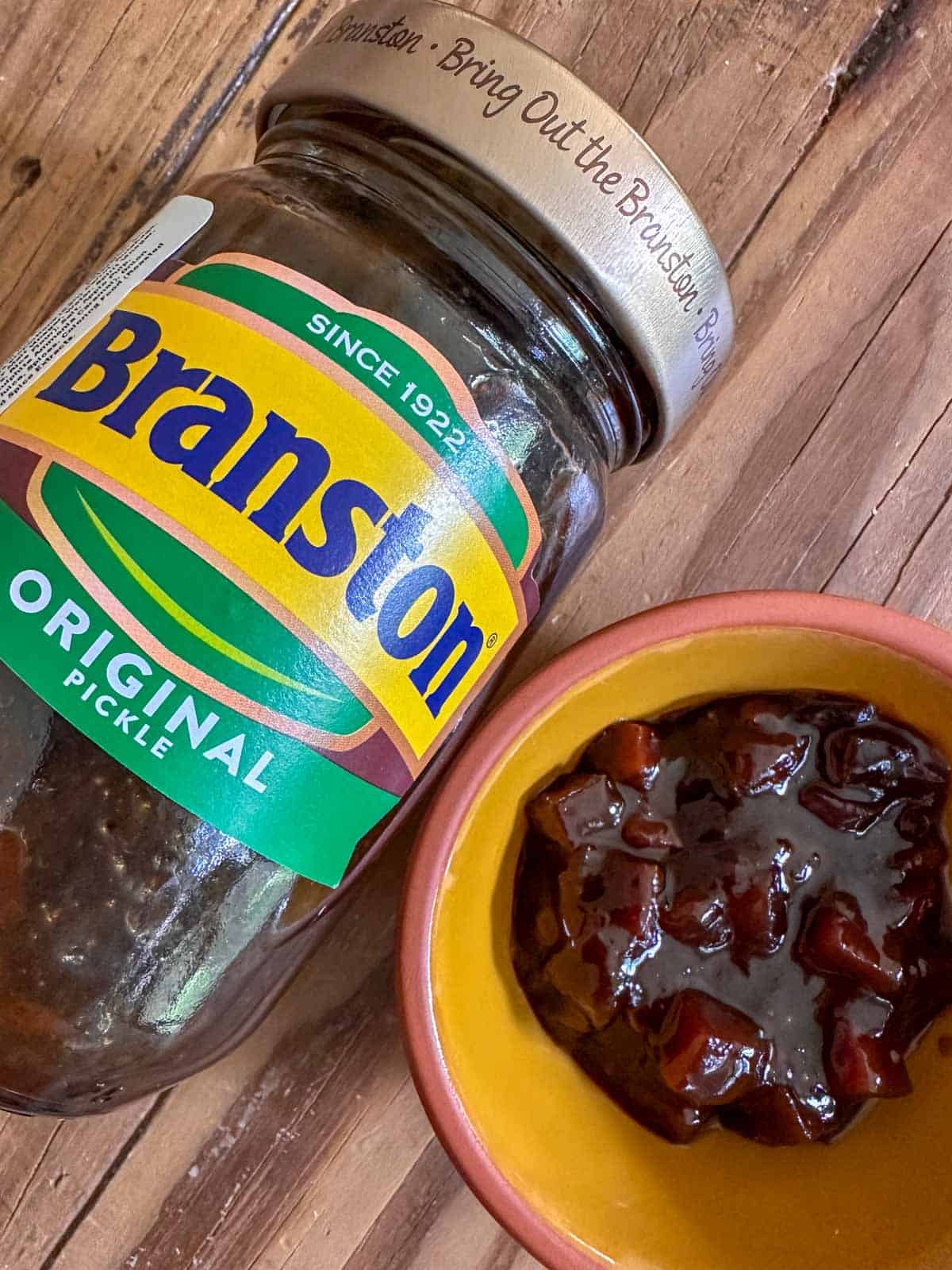
A jar of Branston pickle next to a small bowl with Branston pickle.

Now you need a bit of tang!

Branston Pickle is the traditional choice, a sweet and tangy brown relish made from vegetables and spices. This popular British condiment also offers a HUGE umami flavor with spicy and wonderfully savory notes.

For me, a Ploughman's isn't a Ploughman's without Branston Pickle.

If you can't find it, use mango chutney, apple chutney, or even a good fig spread. The sweetness balances the salt and sharpness of everything else.

Other Essential Ingredients

In addition to the cheese, fresh veg and fruit, and pickle or chutney, the following ingredients will round out your taste of England:

  • Ham - deli ham will work, but ask for it sliced thick. You want substantial pieces that you can fold or tear, not tissue-thin slices that disappear.
  • Crusty bread - I used a French baguette. The bread you use needs structure. Soft sandwich bread turns to mush when you load it with chutney and cheese. Go for a rustic sourdough, or a crusty baguette, with a chewy crumb and crust that crackles when you slice it.
  • Butter - Use salted butter at room temperature so it spreads easily without tearing the crust.

That'll do it for the ingredients! Now on to the best bit!

🔪 Instructions

Prepping

Take out your cheeses and allow to come to room temperature (about 30 minutes). Also let your butter come to room temperature and soften. I also like to let my ham come to room temperature during this time.

In the meantime, prep your ingredients. Wash and slice/cut your veggies and fruit. Slice the bread and put your Branston pickle (or chutney) in some nice bowls.

Add all ingredients to a large plate or platter.

Assembly - No Hard and Fast Rules, Just Recommendations

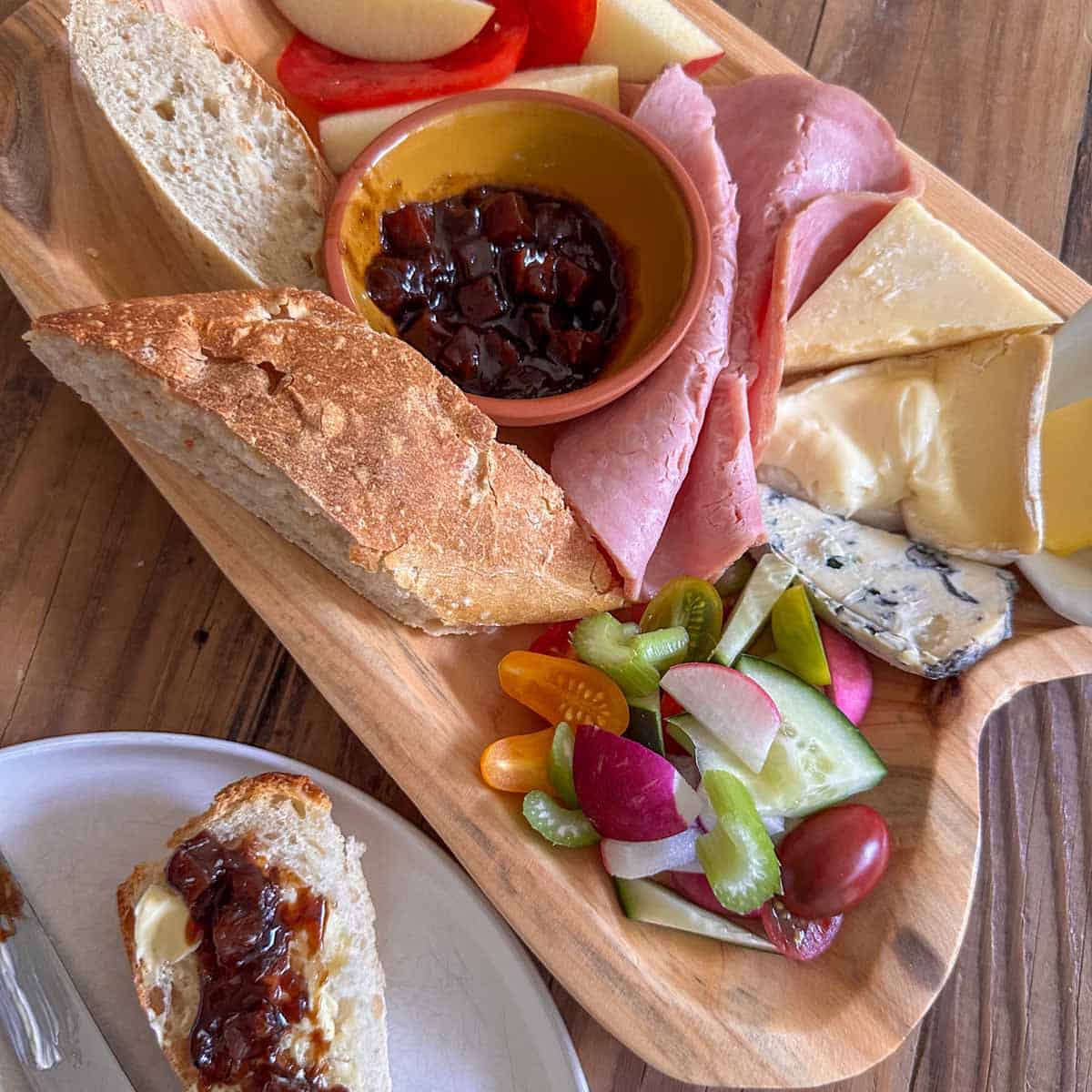
Butter your bread, then add a generous dollop of Branston pickle.

Ploughman's lunch displayed on a wooden platter including cheeses, ham, butter, vegetables, pieces of bread, Branston pickle in a bowl, sliced tomato and apple, next to a plate with a piece of bread slathered with butter and Branston pickled and a knife.


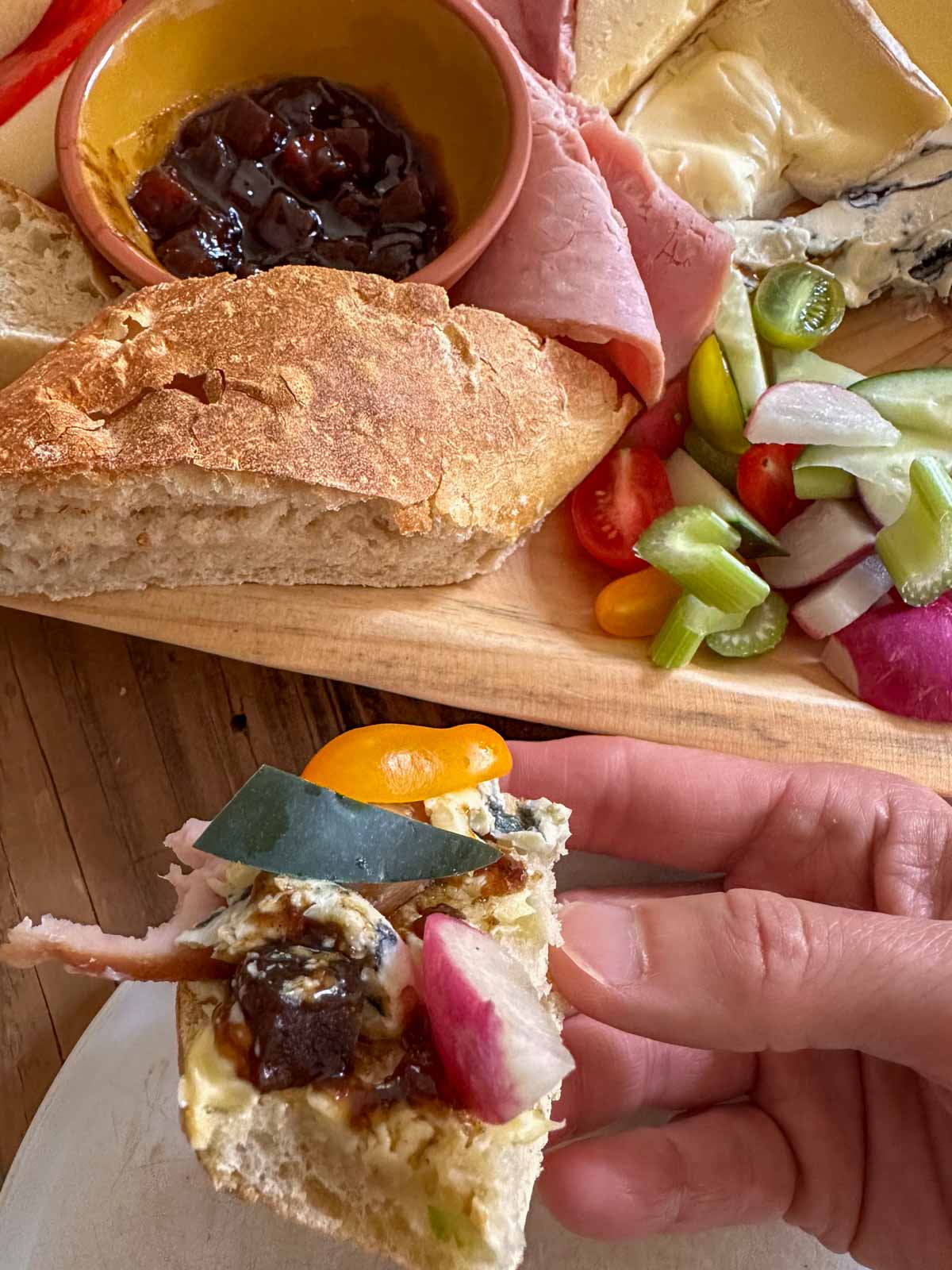
Top with a bit of ham, some cheese, then add some veg. Take a bite, and savor the delicious flavor! Try to create a balance of salty, creamy, tangy, and crunchy in every bite!

Ploughman's lunch displayed on a wooden platter including cheeses, ham, butter, vegetables, pieces of bread, Branston pickle in a bowl, sliced tomato and apple, and a person holding a piece of bread topped with butter, Branston pickle, ham, cheese, and vegetables.

Suggestions For Your Ploughman's Experience

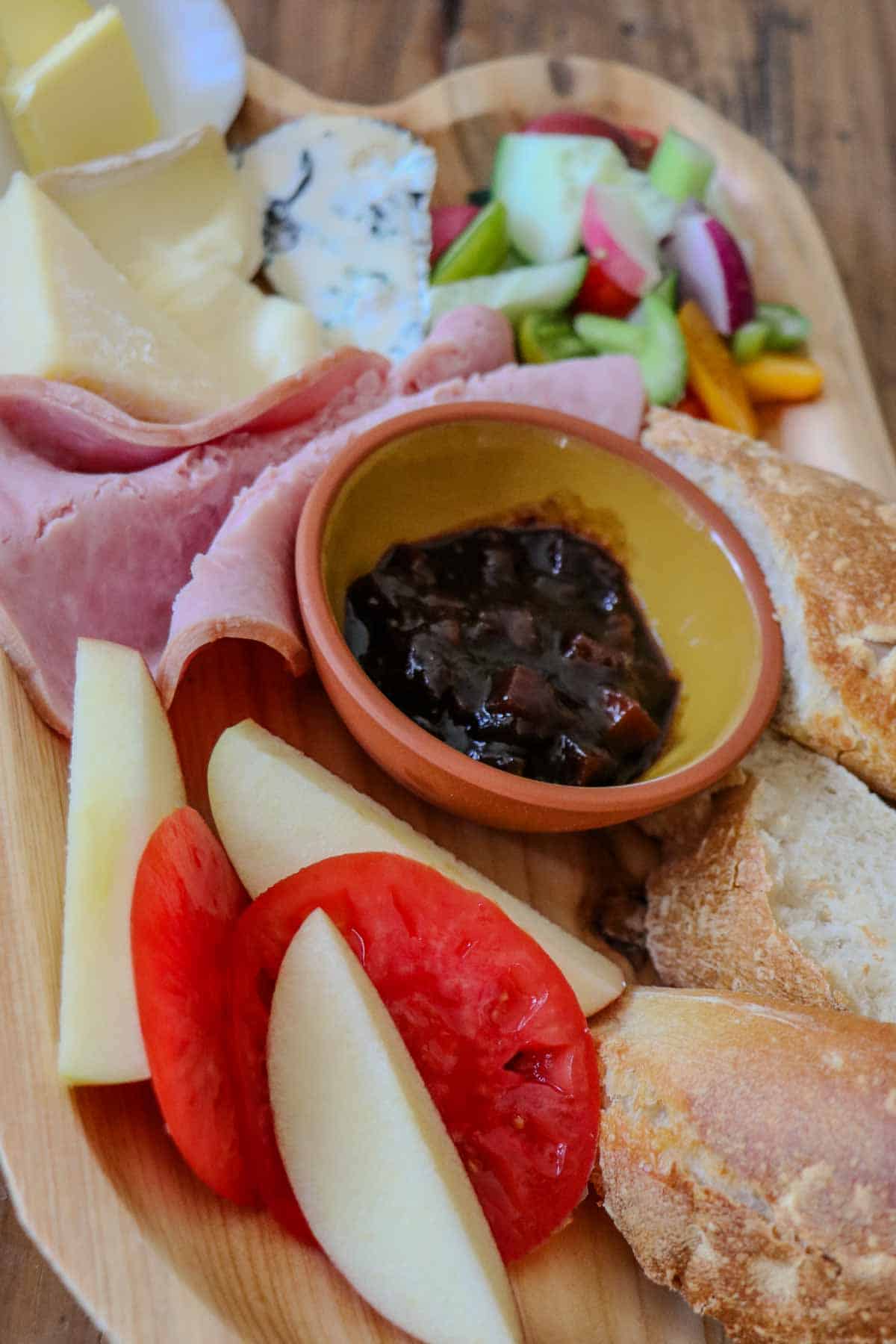
Ploughman's lunch displayed on a wooden platter including cheeses, ham, butter, vegetables, pieces of bread, Branston pickle in a bowl, sliced tomato and apple.

As mentioned, there are no hard and fast rules when it comes to enjoying your authentic pub lunch.

Follow my recommendations, or you can also just opt to graze in whatever way you want, enjoying a bit of apple every now and again!

Pair this platter with a British ale like a pale ale, brown ale, or even a crisp lager. If you want something lighter, a dry cider is perfect.

If you are a wine drinker like I am, then choose a dry Riesling, Chardonnay, or even a light Pinot Noir which will all work nicely.

Teetotal? Then go for some sparkling water with lemon.

Although this lunch is filling enough to stand on its own, if you would like a simple green salad with vinaigrette is all you will need to round out your Ploughman's platter.

Enjoy the Ploughman's experience on your own terms, and walk away from the table completely and utterly filled and satisfied!

FAQ

What type of bread should I include in a Ploughman's platter?

You want a nice crusty bread (not soft sandwich bread). Great choices include a French baguette, or a rustic sourdough. Your bread needs to have structure enough to prevent any sogginess from the chutney and provide some crunch!

What cheeses should I include in a Ploughman's lunch?

If you only include one cheese, let it be a mature English cheddar! Nice and crumbly with outstanding flavor! I also recommend a blue English Stilton, and although not English, a triple cream French brie. This trio is PERFECTION!

Some Other British Recipes You Will Enjoy!

Love British food? Then you'll want to try these recipes:

  • Easy and Scrummy British Beans on Toast - this humble dish is also incredibly delicious especially when topped with cheese!
  • The PERFECT Bacon Sarnie Recipe - bacon sandwiches done the British way is absolute heaven!
  • Scottish Mince and Tatties - minced beef and creamy mashed potatoes never tasted so good!

Join Me On A Fun Food Journey!

I invite you to come along on this food journey with me! Please sign up to get the latest recipes and inspiration for you to expand your food horizons! It's an incredible journey, please join me by signing up here.

Cheers!

Grace

Ploughman's lunch displayed on a wooden platter including cheeses, ham, butter, vegetables, pieces of bread, Branston pickle in a bowl, sliced tomato and apple, next to a plate with a piece of bread slathered with butter and Branston pickled and a knife.

Awesome Authentic Pub-Worthy Ploughman's Lunch Recipe For Real Cravings!

GRACE STEWART
Up your lunch game by indulging in the original British charcuterie board! The Ploughman's Lunch is an English pub classic, easily assembled the lunch you will crave all week long!
5 from 2 votes
Print Recipe Pin Recipe
Prep Time 5 minutes mins
Time for cheese to come to room temperature 30 minutes mins
Total Time 35 minutes mins
Course lunch, Main Course
Cuisine british
Servings 2 people
Calories 1239 kcal

Ingredients
  

Cheese (blocks, not slices!)

  • 6 oz mature English cheddar substitute with aged Gruyère or a firm English cheese like Red Leicester
  • 6 oz blue cheese I recommend English blue stilton, or Saint Agur Blue
  • 6 oz brie I used Saint Angel Triple Cream Brie; could sub camembert

Fresh Veggies and Fruit

  • ¼ cup cherry tomatoes halved
  • ¼ cup radishes sliced or cut into wedges
  • ¼ cup celery sliced
  • ¼ cup cucumber sliced
  • 1 each tomato sliced (Heirloom is fabulous, but you could also use Roma)
  • 1 each apple Cut into wedges; Fuji apple is perfect or choose your favorite!

Remaining Essential Ingredients

  • ½ cup Branston pickle could sub mango chutney or even a fig spread
  • 1 each crusty bread I used a French baguette sliced into 4 pieces (2 for each person)
  • 6 oz ham cut on the thick side
  • 4 tablespoon salted butter
InstacartGet Recipe Ingredients

Instructions
 

Preparation

  • Take out your cheeses and allow to come to room temperature (about 30 minutes). Also let your butter come to room temperature and soften. I also like to let my ham come to room temperature during this time.
  • In the meantime, prep your ingredients. Wash and slice/cut your veggies and fruit. Slice the bread and put your Branston pickle (or chutney) in some nice bowls.
  • Add all ingredients to a large plate or platter.

Assembly - No Hard and Fast Rules, Just Recommendations

  • Butter your bread, then add a generous dollop of Branston pickle.
  • Top with a bit of ham, some cheese, then add some veg. Take a bite, and savor the delicious flavor! Try to create a balance of salty, creamy, tangy, and crunchy in every bite!
  • You can also just opt to graze in whatever way you want, enjoying a bit of apple every now and again.
  • Enjoy the Ploughman's experience on your own terms, and walk away from the table completely and utterly filled and satisfied.

Notes

This recipe serves 2. 
Feel free to adjust the amount of any of the ingredients to your liking and enjoy your Ploughman's experience to the full!

Nutrition

Calories: 1239kcalCarbohydrates: 63gProtein: 55gFat: 85gSaturated Fat: 50gPolyunsaturated Fat: 4gMonounsaturated Fat: 26gTrans Fat: 1gCholesterol: 262mgSodium: 2751mgPotassium: 795mgFiber: 2gSugar: 43gVitamin A: 2017IUVitamin C: 15mgCalcium: 649mgIron: 2mg
Keyword Cheese, ploughman's, ploughman's lunch
Tried this recipe?Let us know how it was!

Easy Spicy Angel Hair Pasta With Tomato Puree Recipe

June 16, 2026 by Grace 1 Comment

Forget everything you know about cooking pasta — this technique will completely change your life! This Easy Spicy Angel Hair Pasta With Tomato Puree uses a genius risotto-style method where the noodles slowly absorb a rich, garlicky tomato broth ladle by ladle — soaking up incredible flavor in every single strand!

Ready in just 15 minutes, budget friendly, and perfect for Meatless Monday — this quick weeknight dinner is finished with a flourish of fresh Italian parsley and Parmigiano Reggiano!

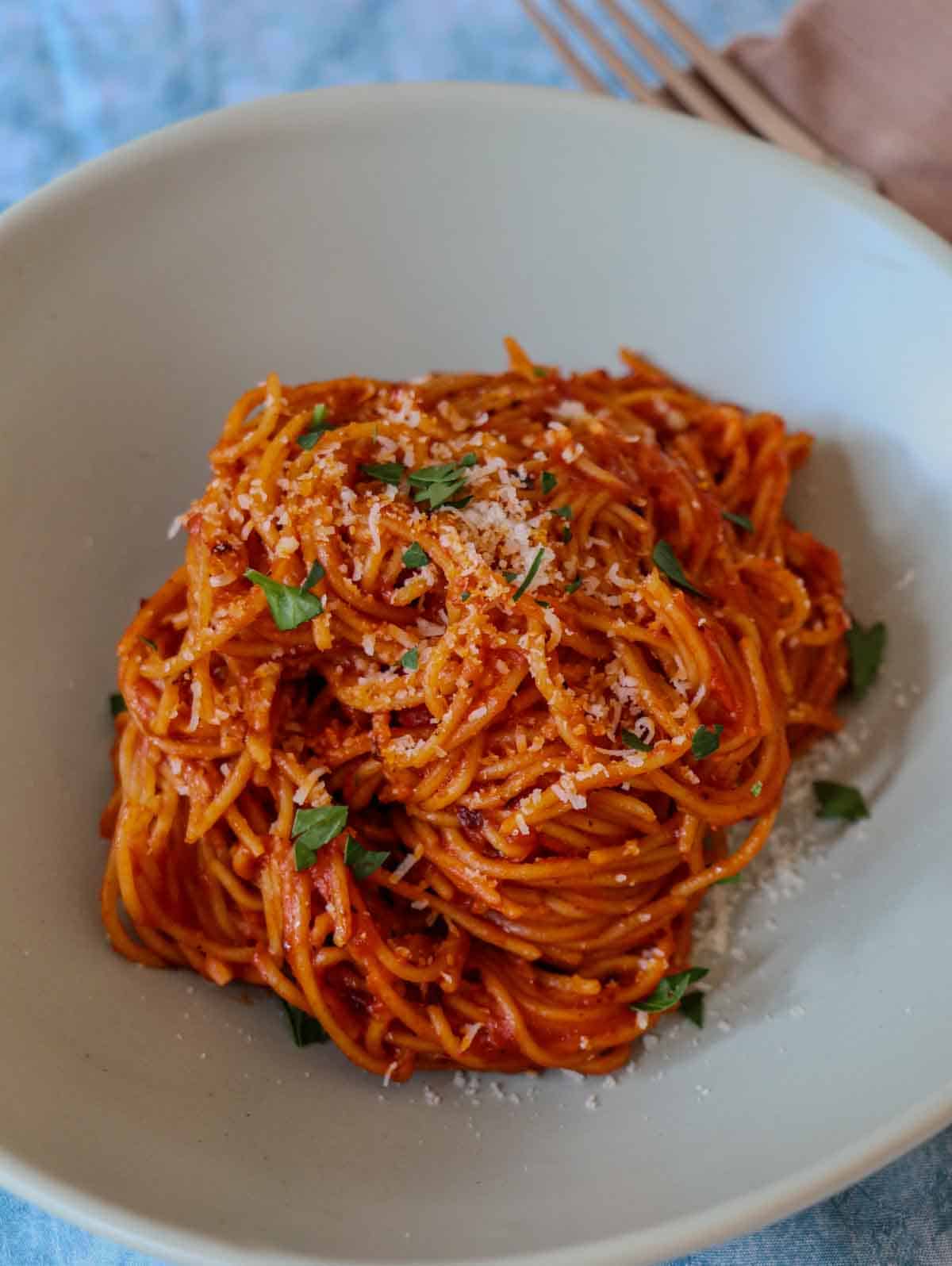
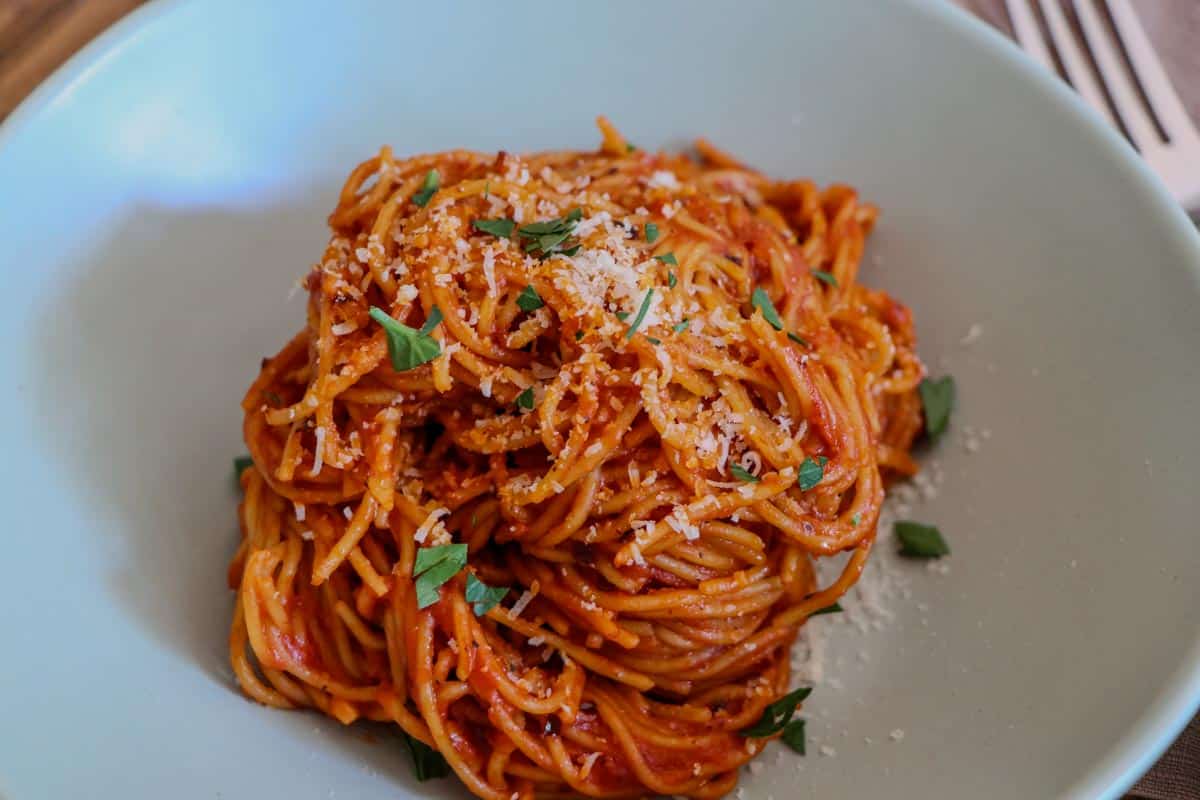
Angel Hair Pasta With Tomato Puree garnished with parsley and Parmesan cheese in a bowl, with a fork on the side.

If you are after an easy and AMAZINGLY DELICIOUS angel hair pasta recipe, then you have come to the right place!

I promise you'll go crazy for the incredible flavor, and you'll have so much fun with the technique used to make this pasta recipe!

Why You Will LOVE This Recipe!

Let me tell you why you will LOVE this angel hair pasta recipe:

  • Enjoy a technique for cooking pasta that may be new to you! Traditional pasta gets boiled in a massive pot of water, but here you'll cook it risotto style with a tomato broth which you will make.
  • You'll feast on pasta with crazy good flavor. The beauty of this dish is that as the noodles absorb the tomato broth, the magic happens, as each noodle takes on the flavor of the delicious broth.
  • This quick recipe is ready in about 15 minutes, so it's perfect for a busy weeknight.
  • This dish is also very budget friendly, and of course it's great for meatless Mondays!
  • Perfect for lovers of spicy food, but also easy to adjust the level of spice to suit your tastes.

So if you are convinced to try this dish, please read on for what you'll need, as well as step by step instructions with pictures!

🍽 Equipment

I recommend you use the following equipment for the best result:

  • Large skillet - you'll need one at least 12" in diameter
  • Medium Saucepan (or Dutch oven) - for making your tomato broth
  • Tongs - aids greatly in cooking the pasta
  • Ladle or ¼ cup measuring cup - use to add tomato broth to the pasta
  • Wooden spoon - or silicone spoon for stirring

🥘 Ingredients

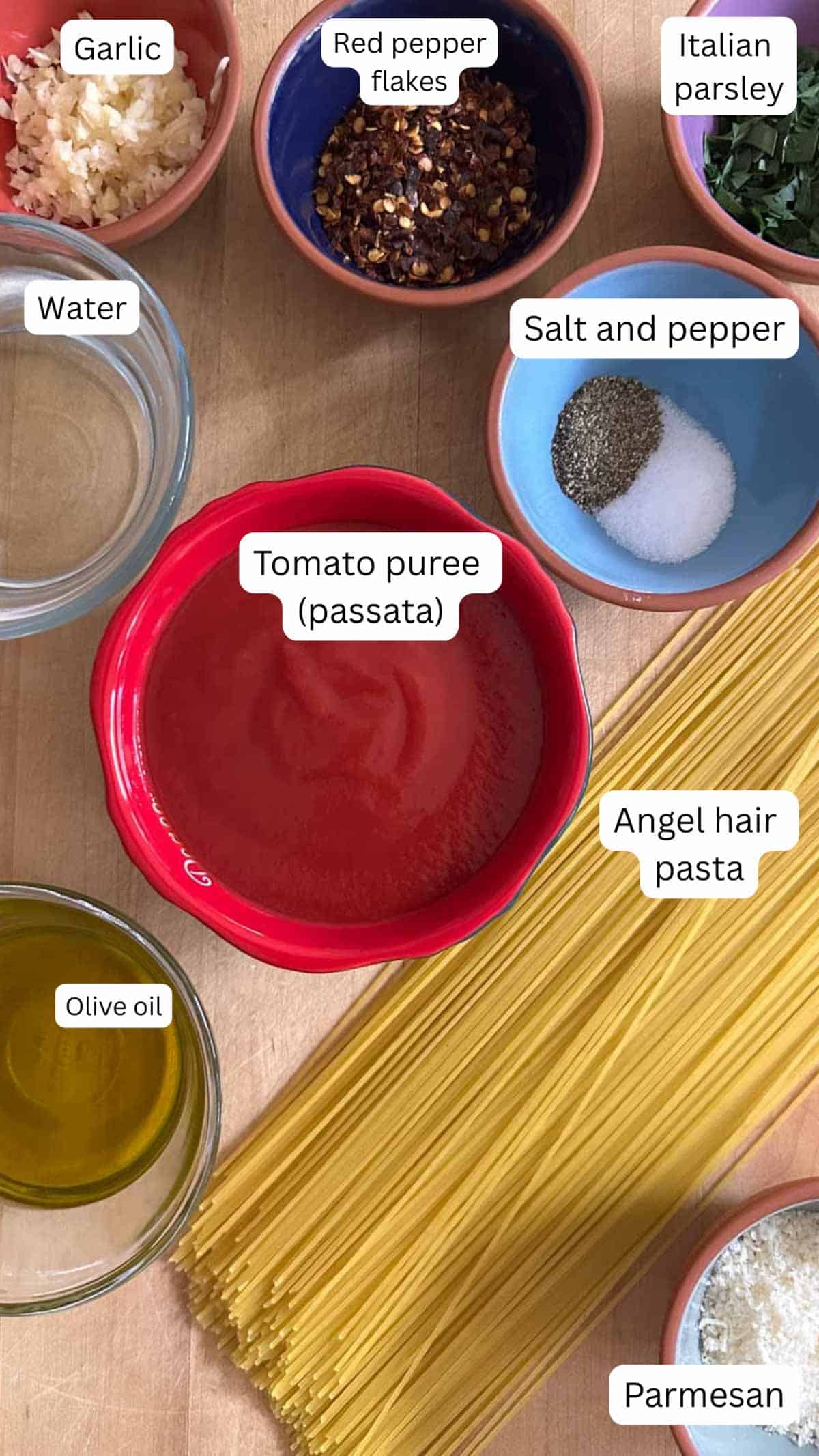
Ingredients for Spicy Angel Hair Pasta With Tomato Puree including pasta, Parmesan, olive oil, tomato puree, salt and pepper, water, garlic, red pepper flakes and Italian parsley.

You only need a few simple ingredients to make this comfort food recipe:

  • Angel hair pasta - use dried pasta, not fresh pasta, for this recipe
  • Red pepper flakes
  • Extra virgin olive oil
  • Tomato puree (aka tomato passata) - please note: don't use tomato sauce or tomato paste for this recipe
  • Water
  • Fresh garlic
  • Salt
  • Black pepper
  • Italian parsley (as garnish)
  • Parmigiano Reggiano (as garnish)

You should easily find all of these ingredients at your local grocery store!

🔪 Instructions

Make The Tomato Broth

Let's begin by making a delicious tomato broth, which will act as your pasta sauce! Add 1 tablespoon of olive oil to a medium saucepan set to medium heat. Sauté for around 30 seconds until the garlic is fragrant, then add the water, tomato puree, salt, and pepper.

Minced garlic and olive oil in a saucepan.
A saucepan containing olive oil and minced garlic, with a small bowl containing tomato puree poised over the saucepan.
A saucepan containing tomato puree, olive oil and garlic, with a person holding a small bowl of water over the saucepan.
A saucepan containing tomato broth with a person holding a small bowl containing salt and pepper over the saucepan.

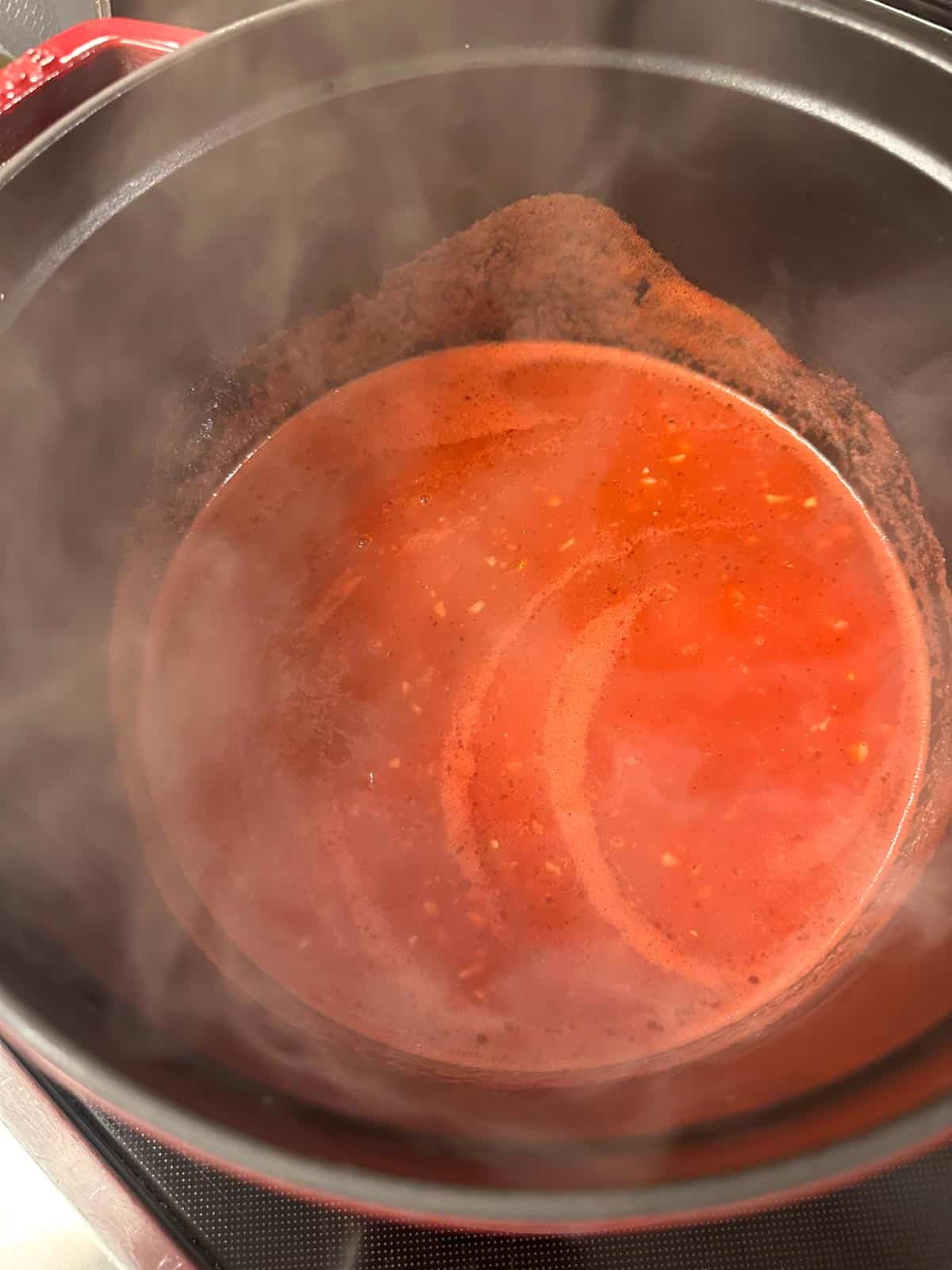
Raise the heat to medium-high to bring this to a simmer, then lower the heat to keep the broth warm.

A saucepan containing simmering tomato broth with steam.

You'll be ladling from this pot and if the tomato broth is cold, it'll lower the pan temperature every time you add it. Keeping it warm prevents that and helps the pasta cook more evenly.

Time To Cook The Pasta In Your Skillet!

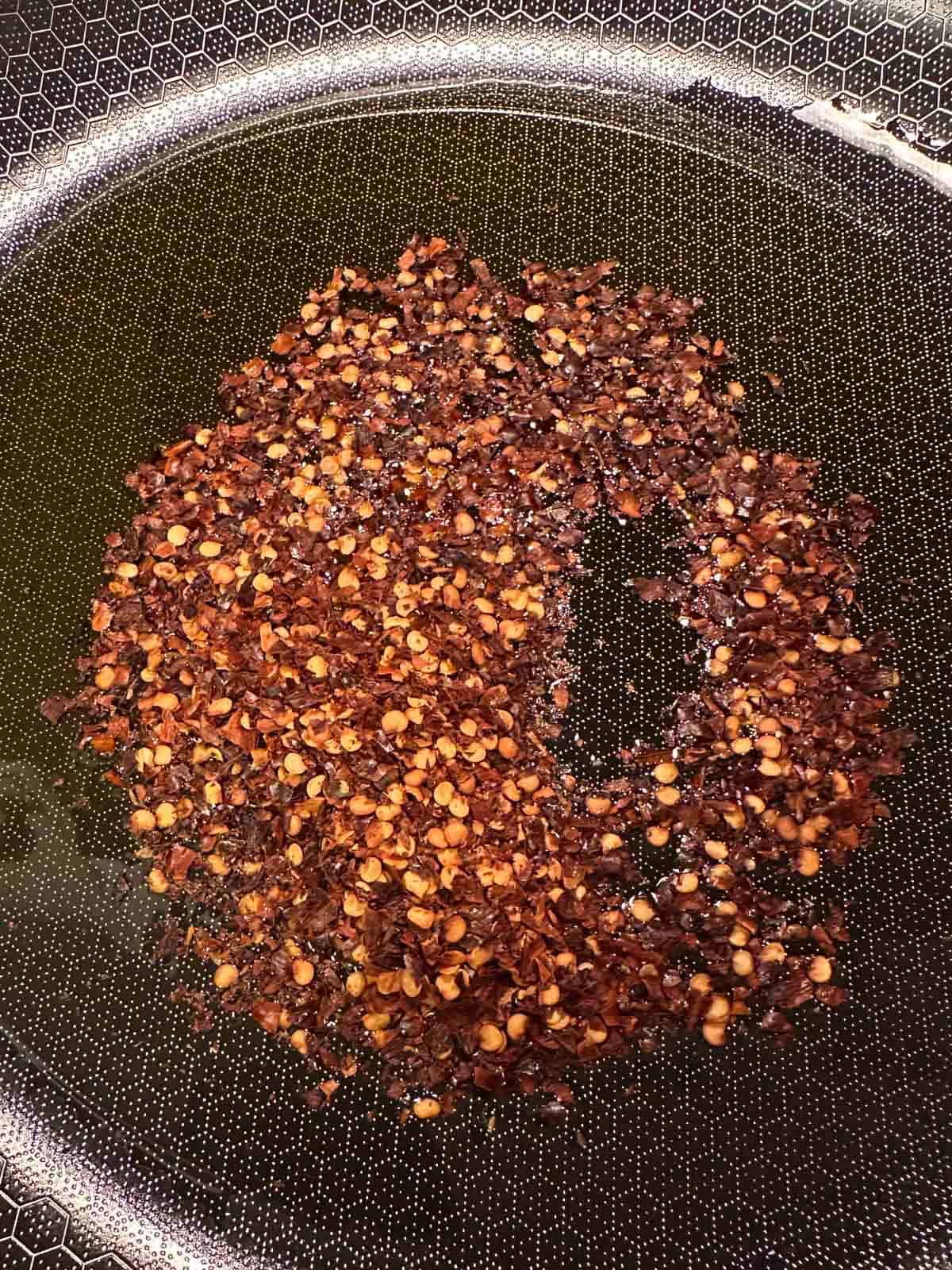
Heat ¼ cup of olive oil on medium heat in your skillet. Once the oil is hot, add the red pepper flakes and allow the chili to "bloom" for about 30 seconds, stirring with a spoon. Blooming releases the flavor of the chili into the oil.

A skillet containing olive oil and red pepper flakes.

Now add the angel hair pasta to your skillet or frying pan, and use the tongs to toss the pasta in the oil.

A skillet containing olive oil, red pepper flakes, and angel hair pasta.
A pair of tongs being used to toss angel hair pasta in an olive oil and red pepper flake mixture in a skillet.

Begin ladling/adding the tomato broth to the pasta in your skillet, approximately ¼ cup. Use the tongs and spoon to help combine the pasta and tomato broth.

A skillet containing angel hair pasta, red pepper flakes and olive oil with a ladle being used to ladle tomato broth onto the pasta.
A pair of tongs being used to toss angel hair pasta absorbing a small amount of tomato broth in an olive oil and red pepper flake mixture in a skillet.

Once the pasta has absorbed the broth, repeat this process until the tomato broth has been used up (about 7 minutes or so).

A skillet containing olive oil, red pepper flakes, and angel hair pasta topped with tomato broth.
A skillet containing angel hair pasta absorbing tomato broth and a ladle containing additional tomato broth over the pasta.

Check the texture - the pasta should be slightly al dente, and it's not meant to be saucy. Add additional salt/pepper if you desire!

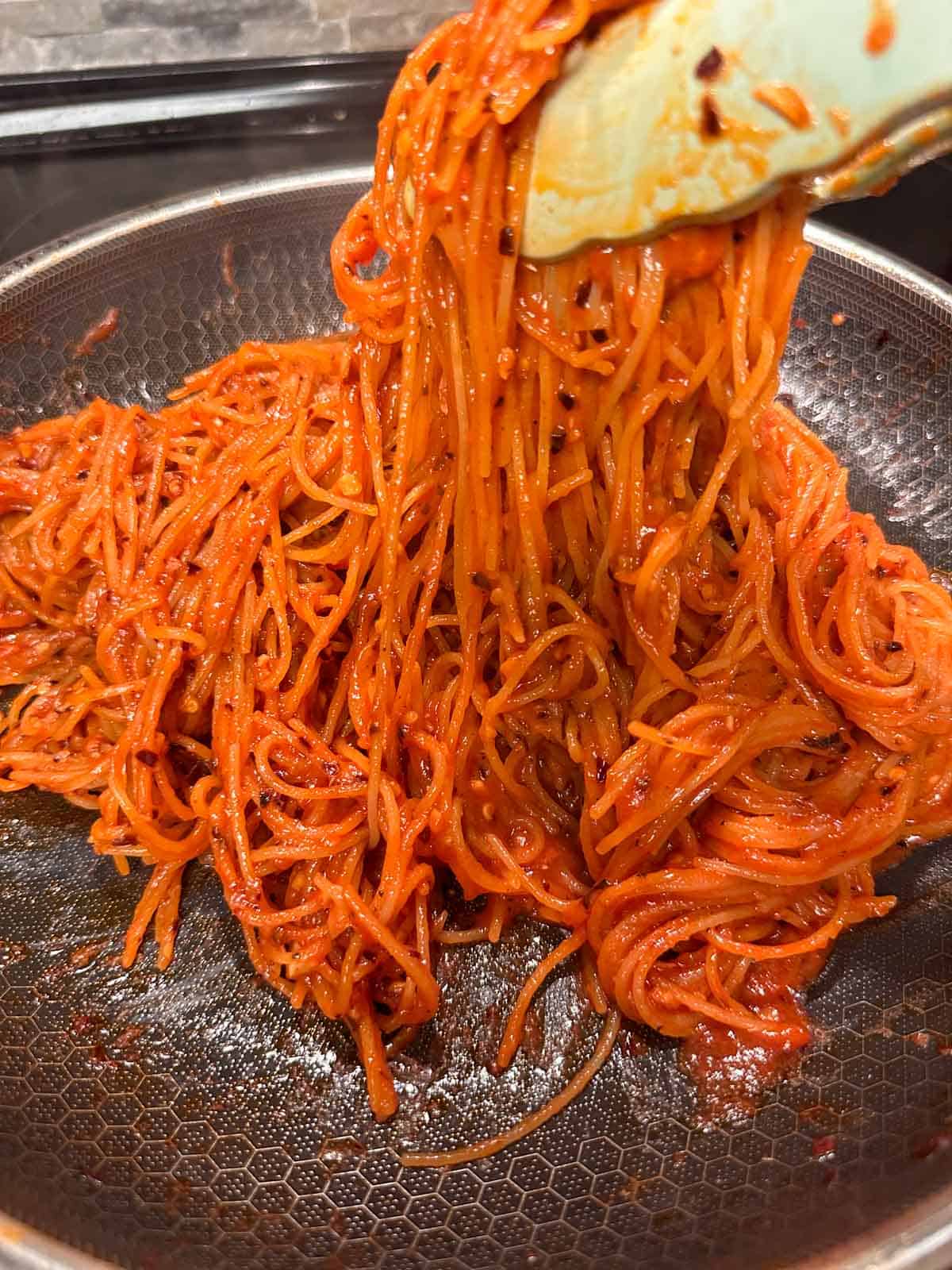
A skillet containing Spicy Angel Hair Pasta With Tomato Puree with a pair of tongs holding some of the pasta.

Suggestions For Enjoying And Serving

Angel Hair Pasta With Tomato Puree garnished with parsley and Parmesan cheese in a bowl, with a fork on the side.

Serve your cooked pasta in elegant bowls, garnished with fresh Italian parsley and Parmigiano Reggiano to taste.

Drizzle some extra virgin olive oil for a little extra indulgence!

You can enjoy this as a main course, accompanied by a lovely green salad.

Or why not try serving it as an accompaniment to some delicious Veal Parmigiana or Chicken Scallopini With Piccata Sauce.

I hope this will become one of your favorite pasta dishes!

Buon Appetito!

FAQ

How should I store any leftover pasta?

In the unlikely event you have any extra pasta leftover, then store in an airtight container in your refrigerator and enjoy within 2 days.

Can I substitute spaghetti for the angel hair pasta?

You can certainly substitute spaghetti for the angel hair pasta. It may take longer to cook and you may need some additional tomato broth, but it will be just as delicious! If using spaghetti you can turn up the heat a bit and let it char and get crispy!

How can I make this pasta saucier (not so dry)?

Please note:  the resulting dish will not be "saucy."  If you would like an extra saucy pasta, then make some more tomato broth to pour over at the end.  Use a 1:1 ratio of tomato puree to water.

Some Other Pasta Recipes You May Enjoy!

Love pasta? Then you'll want to try these other pasta recipes:

  • Easy and Best Linguine With Seafood Mix
  • Pasta Alla Checca (Meatless Spaghetti perfect for the HOTTEST days of summer!)
  • Linguine With Clam Sauce (using canned clams for an easy peasy meal!)

Join Me On A Fun Food Journey!

I invite you to come along on this food journey with me! Please sign up to get the latest recipes and inspiration for you to expand your food horizons! It's an incredible journey, please join me by signing up here.

Cheers!

Grace

Angel Hair Pasta With Tomato Puree garnished with parsley and Parmesan cheese in a bowl, with a fork on the side.

Easy Spicy Angel Hair Pasta With Tomato Puree Recipe

Grace Stewart
This Easy Spicy Angel Hair Pasta With Tomato Puree Recipe delivers incredible intense flavor with every bite! Enjoy the technique of cooking this risotto style in a large skillet, ready to devour in about 15 minutes!
5 from 1 vote
Print Recipe Pin Recipe
Prep Time 8 minutes mins
Cook Time 7 minutes mins
Total Time 15 minutes mins
Course Main Course, Pasta
Cuisine Italian
Servings 4 people
Calories 559 kcal

Equipment

  • 1 Large skillet you'll need one at least 12" in diameter
  • 1 Medium Saucepan for making your tomato broth
  • tongs aids greatly in cooking the pasta
  • ladle or ¼ cup measuring cup use to add tomato broth to the pasta
  • wooden spoon or silicone spoon for stirring

Ingredients
  

  • 12 oz angel hair pasta dried
  • 2 tablespoon red pepper flakes feel free to adjust the amount to your tastes; I use 2 tablespoon because I like it spicy!
  • ¼ cup olive oil

Tomato Broth

  • 3 cups tomato puree aka tomato passata (don't use tomato sauce or tomato paste)
  • 3 cups water
  • 1 tablespoon olive oil
  • 6 cloves garlic minced
  • 1 ts salt plus additional to taste
  • ½ ts pepper plus additional to taste

Garnishes

  • 2 tablespoon Italian parsley finely chopped
  • Parmigiano Reggiano as much as you want!
InstacartGet Recipe Ingredients

Instructions
 

Make The Tomato Broth

  • Let's begin by making a delicious tomato broth! Add 1 tablespoon of olive oil to a medium saucepan set to medium heat. Sauté for around 30 seconds until the garlic is fragrant, then add the water, tomato puree, salt, and pepper.
  • Raise the heat to medium-high to bring this to a simmer, then lower the heat to keep the broth warm.
  • You'll be ladling from this pot and if the tomato broth is cold, it'll lower the pan temperature every time you add it. Keeping it warm prevents that and helps the pasta cook more evenly.

Time To Cook The Pasta In Your Skillet!

  • Heat ¼ cup of olive oil on medium heat in your skillet. Once the oil is hot, add the red pepper flakes and allow the chili to "bloom" for about 30 seconds, stirring with a spoon. Blooming releases the flavor of the chili into the oil.
  • Now add the angel hair pasta to your skillet, and use the tongs to toss the pasta in the oil.
  • Begin ladling/adding the tomato broth to the pasta in your skillet, approximately ¼ cup. Use the tongs and spoon to help combine the pasta and tomato broth. Once the pasta has absorbed the broth, repeat this process until the tomato broth has been used up (about 7 minutes or so).
  • Check the texture - the pasta should be slightly al dente, and it's not meant to be saucy. Add additional salt/pepper if you desire.

Plate and Enjoy!

  • Serve your pasta in some gorgeous pasta bowls, garnished with some Italian parsley and as much Parmigiano Reggiano as you desire! Drizzle some extra virgin olive oil for a little extra indulgence! Buon Appetito!

Notes

Please note:  the resulting dish will not be "saucy."  If you would like an extra saucy pasta, then make some more tomato broth to pour over at the end.  Use a 1:1 ratio of tomato puree to water.

Nutrition

Calories: 559kcalCarbohydrates: 85gProtein: 15gFat: 19gSaturated Fat: 3gPolyunsaturated Fat: 3gMonounsaturated Fat: 13gSodium: 718mgPotassium: 1161mgFiber: 8gSugar: 12gVitamin A: 2358IUVitamin C: 25mgCalcium: 84mgIron: 6mg
Keyword angel hair pasta, Pasta
Tried this recipe?Let us know how it was!

Easy Homemade Salted Chicken Egg Yolks Recipe

May 1, 2026 by Grace 4 Comments

You can turn regular egg yolks into the richest, most umami-packed ingredient in your kitchen with just salt, sugar, and a little patience! You'll want to put this popular delicacy on everything be sure to give it a try!

A wire rack with 3 cured salted egg yolks, and a person holding an additional salted egg yolk over the rack.

I first came across salted egg when I was gifted some Irvin's Salted Egg Fish Skins.

This dangerously addictive snack, which has salted duck egg yolks as its main ingredient, blew me away with its incredible umami flavor. Here began my love for salted egg!

And now I'm thrilled to share with you a homemade recipe for salted egg yolks, using chicken eggs.

Use these to elevate almost any dish to another level. Once you try them, you'll always want to have these on hand!

But first, allow me to tell you a little bit about salted egg yolks!

Jump to:
  • What Is Salted Egg Yolk?
  • 🍽 Equipment
  • 🥘 Ingredients
  • 🔪 Instructions
  • Suggestions For Enjoying And Serving
  • FAQ
  • Some Other Recipes You May Enjoy!
  • Join Me On A Fun Food Journey!
  • Easy Homemade Salted Chicken Egg Yolks Recipe

What Is Salted Egg Yolk?

Salted duck eggs have been a preservation staple in China for centuries, and they are a popular ingredient in Asian cuisine. For example, you will see them grated over congee, included in moon cakes, or whipped into sauces that coat everything from crabs to potato chips.

There are different ways to cure eggs and egg yolks.

The traditional way of creating salted duck eggs included curing the eggs in a brine solution or salted charcoal, and these are still used today in Asian countries.

The brining process typically takes about 20-30 days, so great patience is needed for this method. 😁

Over time, cooks realized the yolks were the real prize. Dense, creamy, and packed with umami, they became a standalone ingredient rather than just a preserved egg.

The modern way skips the clay and fresh duck eggs in favor of chicken yolks cured in straight salt, a combination of salt and sugar, or a simple brine method.

In the west, salted egg yolks are typically produced using dry methods (my favorite way to cure egg yolks), which is what you will find here. This method (much quicker than brining!) produces more of a firm texture, suitable for grating.

The resulting cured egg yolk has a rich salty umami flavor which enhances anything it touches!

Interested? Please read on to find out what you'll need to make this umami flavor bomb!

🍽 Equipment

You don't need much in the way of equipment to make salted egg yolks, but you will need the following:

  • Small deep container, preferably with a lid (this will need to be deep enough so that it will hold the yolk and layers of salt and sugar, and wide enough so that the yolks do not touch each other). I used an airtight container from a set I bought on Amazon (affiliate link). If you're looking for a good affordable glass storage set for food you can't go wrong with this one.
  • Small bowl
  • Wire rack (for use when drying out your yolks in the oven)

🥘 Ingredients

Measuring cups filled with fine salt and sugar, and a glass container with egss.

This recipe is adapted from Ottolenghi Test Kitchen Extra Good Things "Creamed Spinach With Paprika Pine Nuts and Cured Yolks."

You only need 3 ingredients to make this salted yolks recipe:

  • Fine Salt - I used fine table salt, but you can also use sea salt
  • Sugar - sugar is included in the cure to balance out and mellow the saltiness just a bit
  • Chicken egg yolks - I used regular eggs (fresh and pasture raised with bright orange yolk) that I bought from my grocery store

You most likely won't even have to go shopping as I would hazard a bet that you may already have these 3 ingredients!

Now on to the easy instructions!

🔪 Instructions

Mix the salt and sugar in a small bowl. Place half of this mixture in your container, and make 2 small wells (in which your yolks will sit) using a spoon. Space these apart so that the yolks won't be touching each other.

A bowl containing a salt and sugar mixture with a spoon.
A glass container with salt and sugar, and a person using a spoon to make wells in the mixture.

Separate the egg yolks from the egg whites, and carefully place a yolk in each of the wells. Try not to break the yolk, but it's ok if you do (just a little bit though!). Pour the remaining mixture over the egg yolks so that they are completely covered.

A glass container with sugar and salt with two egg yolks.
A glass dish containing a mixture of salt and sugar topped with two egg yolks, and a spoon with salt poised over the yolks poised to sprinkle the salt over the yolks.
A glass container with salt and sugar.

Place the lid on your container, and refrigerate the mixture for about 2 days. If you don't have a lid, you can also use plastic wrap.

After the 2 days, use a spoon to lift the yolks out one at a time. Rinse each one gently under cold water to remove excess salt and sugar from the surface. Pat dry with a paper towel.

Preheat your oven to 175F. Place the yolks on a wire rack and then dry them in the oven for about 2 hours.

Two salted egg yolks on a wire rack.

Remove from your oven and allow to cool to room temperature. Your salted egg yolks are ready to enjoy or can be stored in your fridge for 3 weeks or so!

You'll find a printable recipe card with step by step instructions below!

Suggestions For Enjoying And Serving

A wire rack with 3 cured salted egg yolks, and a person holding an additional salted egg yolk over the rack.

Don't the cured egg yolks look like apricots? 😃

So let me first say you can be forgiven for enjoying these salted egg yolks as a snack. It's best to just take small bites, savoring each umami filled bite while closing your eyes.

Some other ideas are adding them to your delicious homemade food. Here are some suggestions:

  • Roasted or sautéed vegetables - use a microplane or zester to grate your yolks over your veggies
  • Pasta - grate over hot pasta
  • Fried Rice - chop up the yolks and add them right at the end
  • Potatoes or sweet potatoes - grate over the top when hot, and enjoy with lots of butter!

Once you've made a batch, you'll start seeing ways to use them everywhere!

FAQ

How should I store my salted egg yolks?

Store your salted egg yolks in your refrigerator in an airtight container.

Why do we need to put the salted yolks in the oven after curing?

The oven serves to dry the yolks out so that they firmer and easier to grate.

Some Other Recipes You May Enjoy!

Here are some other recipes for flavor bomb sauces that you may enjoy:

  • Easy 3 Ingredient Miso Sauce With Butter
  • Spicy Thai Chili Oil
  • Make Your Own Delicious Chinese Black Bean Sauce!

Join Me On A Fun Food Journey!

I invite you to come along on this food journey with me! Please sign up to get the latest recipes and inspiration for you to expand your food horizons! It's an incredible journey, please join me by signing up here.

Cheers!

Grace

A wire rack with 3 cured salted egg yolks, and a person holding an additional salted egg yolk over the rack.

Easy Homemade Salted Chicken Egg Yolks Recipe

GRACE STEWART
You can turn regular egg yolks into the richest, most umami-packed ingredient in your kitchen with just salt, sugar, and a little patience! You'll want to put this on everything be sure to give it a try!
Print Recipe Pin Recipe
Prep Time 5 minutes mins
Cook Time 2 hours hrs
Curing Time 2 days d
Total Time 2 days d 2 hours hrs 5 minutes mins
Course accompaniment, seasoning
Cuisine Asian
Servings 2 servings
Calories 3 kcal

Equipment

  • small deep container, preferably with a lid this will need to be deep enough so that it will hold the yolk and layers of salt and sugar, and wide enough so that the yolks do not touch each other
  • wire rack
  • Small bowl

Ingredients
  

  • 2 each egg yolks this recipe uses chicken eggs
  • ½ cup fine salt
  • ¼ cup sugar
InstacartGet Recipe Ingredients

Instructions
 

  • Mix the salt and sugar in a small bowl. Place half of this mixture in your container, and make 2 small wells (in which your yolks will sit) using a spoon. Space these apart so that the yolks won't be touching each other.
  • Separate the egg yolks from the egg whites, and carefully place a yolk in each of the wells. Try not to break the yolk, but it's ok if you do (just a little bit though!). Pour the remaining mixture over the egg yolks so that they are completely covered.
  • Place the lid on your container, and refrigerate the mixture for about 2 days. If you don't have a lid, you can also use plastic wrap.
  • After the 2 days, use a spoon to lift the yolks out one at a time. Rinse each one gently under cold water to remove excess salt and sugar from the surface. Pat dry with a paper towel.
  • Preheat your oven to 175F. Place the yolks on a wire rack and then dry them in the oven for about 2 hours.
  • Remove from your oven and allow to cool. Your salted egg yolks are ready to enjoy or can be stored in your fridge for 3 weeks or so!

Notes

This recipe is adapted from Ottolenghi Test Kitchen Extra Good Things "Creamed Spinach With Paprika Pine Nuts and Cured Yolks"
Although salt and sugar are ingredients in this recipe, for nutritional purposes here only  the nutrient values of the eggs are calculated, as the salt and sugar will not be consumed.
This recipe is easily doubled.

Nutrition

Calories: 3kcalCarbohydrates: 0.04gProtein: 0.2gFat: 0.3gSaturated Fat: 0.1gPolyunsaturated Fat: 0.04gMonounsaturated Fat: 0.1gCholesterol: 11mgSodium: 0.5mgPotassium: 1mgSugar: 0.01gVitamin A: 14IUCalcium: 1mgIron: 0.03mg
Keyword salted egg yolk
Tried this recipe?Let us know how it was!

Korean Carrot Salad With Coriander Recipe (Morkovcha)

April 21, 2026 by Grace Leave a Comment

Meet Morkovcha! This vibrant, crunchy, and addictive Korean-style carrot salad is a staple in Korean-Russian cuisine. With its perfect balance of spicy, tangy, and slightly sweet flavors, this colorful dish makes an excellent side or appetizer!

Matchstick carrots (Korean carrot salad) garnished with cilantro on a patterned plate with chopsticks.

Koreans can't live without their kimchi! But what if you were a Korean not able to find napa cabbage or other common ingredients needed to make your kimchi? You improvise!

This improvisation produced a most incredible Korean carrots dish called morkovcha (meaning Korean carrots)!

Please read on for a little information as to where this fresh carrot salad came from!

Jump to:
  • What is Morkovcha?
  • 🥘 Ingredients
  • 🔪 Instructions
  • Suggestions For Enjoying And Serving
  • FAQ
  • Some Other Recipes You May Enjoy!
  • Join Me On A Fun Food Journey!
  • Korean Carrot Salad With Coriander Recipe (Morkovcha)

What is Morkovcha?

In the 1860's, many ethnic Koreans left Korea and crossed over into Russia escaping harsh conditions brought by drought and famine.

However in the 1930's, Joseph Stalin forced these Korean immigrants, who were known as Koryo-saram, to relocate to parts of Central Asia (such as Uzbekistan) because he deemed them "unreliable people". This was a brutal relocation which resulted in many deaths.

Morkovcha originated from the Korean diaspora into parts of Central Asia including Uzbekistan.

When Koreans were deported to Central Asia in the 1930s, they adapted their traditional recipes using locally available ingredients. Carrots became a substitute for harder-to-find vegetables (like napa cabbage), and this raw carrot salad was born.

Today, this spicy carrot salad with seriously exciting flavors is enjoyed throughout former Soviet Union countries and has gained popularity worldwide as a delicious and healthy side dish.

I urge you to please take a moment to remember the history of this popular salad when preparing and enjoying it!

🥘 Ingredients

Ingredients for Korean Carrot Salad displayed in bowls including carrots, garlic, olive oil, sugar, rice vinegar, cilantro, coriander seeds, salt, and gochugaru.

Here are the ingredients you will need for this delicious and spicy Korean carrot salad recipe:

  • Fresh carrots - you'll need to peel and julienne them, or cut them into matchsticks. To make it super simple, buy a bag of precut matchstick carrots!
  • Fresh garlic
  • Olive oil (can sub vegetable oil)
  • Sugar
  • Rice vinegar
  • Cilantro
  • Whole coriander seeds (you'll coarsely grind them for this recipe)
  • Salt
  • Gochugaru (Korean chili flakes)

You should be able to find these ingredients at most grocery stores, but you may need to shop an Asian grocery store for the gochugaru.

🔪 Instructions

Prepare your carrots by using a julienne peeler to cut the carrots into thin strips. Save time by using precut matchstick carrots (which is what I used for this recipe).

Place the matchstick or julienned carrots in a small mixing bowl, then add the salt and mix it in by hand. Let sit for about 15 minutes, and then use your hands to squeeze out any excess moisture (remove as much of this as you can).

A glass bowl with salted matchstick carrots and a small bowl with salt poised over the bowl.
Salt the carrots and let sit for about 15 minutes...
Matchstick carrots in a glass bowl with a person pushing back some of the carrots to reveal liquid released by the carrots.
The carrots will release some moisture...
A glass bowl with matchstick carrots and a person's hand squeezing liquid out of the carrots.
Squeeze the carrots to get rid of excess moisture so that your salad won't turn out watery.

Add the dressing ingredients (sugar, rice vinegar, and gochugaru) to a small bowl, and use a spoon to combine well. Now combine this dressing with the carrots and set aside for now.

A bowl with gochugaru and rice vinegar with a spoon, next to a mortar and pestle with ground coriander seeds.
Combine the dressing ingredients in a small bowl...
A glass bowl with matchstick carrots and a gochugaru paste with a yellow spoon with a wooden handle.
Add to the salted carrots...
A glass bowl containing matchstick carrots and a yellow spoon with a wooden handle.
Stir to combine well.

Heat the oil in a small skillet over medium-low heat. Add the garlic and saute until aromatic (about 30 seconds), and then add the ground coriander seeds and saute for another 30 seconds or so until the seeds release their fragrance.

Pour the hot oil over the carrots and then add the fresh cilantro. Stir to combine well.

A skillet with oil, garlic, and coriander seeds and a wooden spoon.
Make the aromatic hot oil....
A glass bowl with matchstick carrots and a spoon and a skillet with garlic, oil, and coriander seeds poised over the glass bowl.
Then pour this over the carrots...
A glass bowl with matchstick carrots dressed with a gochugaru based dressing topped with cilantro, and a yellow spoon with a wooden handle in the bowl.
Finally add the fresh cilantro.

Feel free to adjust for your taste by adding more salt, rice vinegar, or gochugaru.

Behold your beautiful Morkovcha!

A glass bowl with matchstick carrots dressed with a gochugaru based dressing and cilantro, and a yellow spoon with a wooden handle in the bowl.

Suggestions For Enjoying And Serving

Matchstick carrots (Korean carrot salad) garnished with cilantro on a patterned plate with chopsticks.

Your Korean carrots dish can be eaten after cooling to room temperature, or better yet store them in an airtight container in your fridge and enjoy after chilling for a few hours or next day for maximum flavor. They actually taste better the next day!

Morkovcha is incredibly versatile and pairs well with many dishes. Serve this Korean salad as a delicious side dish with grilled meats, particularly Korean barbecue like galbi and bulgogi.

It also makes an excellent addition to rice bowls, wraps, and sandwiches.

I hope this nutritious Korean carrot dish will be a part of your regular dinner rotation!

FAQ

Can I make this salad less spicy?

Yes! Simply vary the amount of gochugaru to suit your taste. Better to start with a little and add as you go to suit your tolerance for spice!

Do I have to use fresh coriander?

Fresh coriander adds authentic flavor, but if you dislike it then no worries you can leave it out.

Some Other Recipes You May Enjoy!

Here are some other Korean side dish recipes you may enjoy:

  • Korean Spicy Bean Sprouts
  • Korean Zucchini Side Dish Recipe
  • Quick and Easy Cucumber Kimchi

Join Me On A Fun Food Journey!

I invite you to come along on this food journey with me! Please sign up to get the latest recipes and inspiration for you to expand your food horizons! It's an incredible journey, please join me by signing up here.

Cheers!

Grace

Matchstick carrots (Korean carrot salad) garnished with cilantro on a patterned plate with chopsticks.

Korean Carrot Salad With Coriander Recipe (Morkovcha)

Grace Stewart
This vibrant, crunchy, and addictive Korean-style carrot salad, aka Morkovcha, is spicy, tangy, and slightly sweet. This colorful dish makes an excellent side or appetizer!
Print Recipe Pin Recipe
Prep Time 15 minutes mins
Cook Time 3 minutes mins
Resting time (salting the carrots) 15 minutes mins
Total Time 33 minutes mins
Course Appetizer, Side Dish
Cuisine Korean, Uzbek
Servings 4 servings
Calories 144 kcal

Equipment

  • julienne peeler optional (not needed if you use precut matchstick carrots)
  • small mixing bowl for salting carrots and combining them with the dressing
  • Small bowl for combining dressing ingredients
  • Small skillet for making the aromatic oil

Ingredients
  

  • 10 oz carrots you can use precut matchstick carrots, or even better use a julienne peeler to julienne whole carrots
  • 1 ts salt
  • 2 tablespoon cilantro finely chopped

Dressing Ingredients

  • 1.5 tablespoon rice vinegar
  • 2 ts gochugaru Korean red pepper flakes; vary the amount according to taste (add more for a more spicy salad!)
  • 1 tablespoon sugar

Aromatic Oil Ingredients

  • 3 tablespoon olive oil can sub vegetable oil
  • 6 cloves fresh garlic minced
  • 1 ts coriander seeds coarsely ground (you can use a pestle and mortar or grind for a few seconds in a spice/coffee grinder)
InstacartGet Recipe Ingredients

Instructions
 

  • Prepare your carrots by using a julienne peeler to cut the carrots into thin strips. Save time by using precut matchstick carrots (which is what I used for this recipe). Place the carrots in a small mixing bowl, then add the salt and mix it in by hand. Let sit for about 15 minutes, and then use your hands to squeeze out any excess moisture (remove as much of this as you can).
  • Add the dressing ingredients (sugar, rice vinegar, and gochugaru) to a small bowl, and use a spoon to combine well. Now combine this dressing with the carrots and set aside for now.
  • Heat the oil in a small skillet over medium-low heat. Add the garlic and saute until aromatic (about 30 seconds), and then add the ground coriander seeds and saute for another 30 seconds or so until the seeds release their fragrance.
  • Pour the hot oil over the carrots and then add the fresh cilantro. Stir to combine well. Feel free to adjust for your tastes by adding more salt, rice vinegar, or gochugaru.
  • The carrots can be eaten after cooling to room temperature, or better yet store them in an airtight container in your fridge and enjoy after chilling for a few hours or next day. They actually taste better the next day!

Notes

For convenience sake I used precut matchstick carrots.  However, for best results julienne your own carrots because julienned carrots will absorb the dressing better than precut matchsticks. 

Nutrition

Calories: 144kcalCarbohydrates: 12gProtein: 1gFat: 11gSaturated Fat: 1gPolyunsaturated Fat: 1gMonounsaturated Fat: 8gSodium: 640mgPotassium: 262mgFiber: 2gSugar: 6gVitamin A: 12002IUVitamin C: 6mgCalcium: 37mgIron: 1mg
Keyword carrot salad, morkovcha
Tried this recipe?Let us know how it was!

Easy Japanese Cabbage Recipe With Butter & Soy Sauce

March 30, 2026 by Grace Leave a Comment

This is one of the easiest and most delicious ways to enjoy cabbage! All you need for this umami-packed side dish are 4 simple ingredients and a few minutes to enjoy this mouthwatering Japanese Cabbage With Butter & Soy Sauce!

Japanese cuisine makes great use of cabbage. From Japanese cabbage salad served with tonkatsu, to yamitsuki cabbage, this nutritious and budget friendly vegetable finds its way into plenty of meals at Japanese restaurants and homes.

But one of the simplest and most addictive ways to enjoy Japanese style cabbage is to cook it with butter and soy sauce. In this preparation the cabbage caramelizes and softens at the same time, and it has become one of my favorite ways to enjoy this beautiful vegetable.

It is a staple in Japanese households because it is fast, cheap, and pairs with nearly everything from grilled fish to fried rice.

I believe this will become a staple at your dinner table too!

Let me show you what you'll need to make this simple side dish featuring cabbage!

Jump to:
  • 🍽 Equipment
  • 🥘 Ingredients
  • 🔪 Instructions
  • Suggestions For Enjoying And Serving
  • FAQ
  • Some Other Recipes You May Enjoy!
  • Join Me On A Fun Food Journey!
  • Easy Japanese Cabbage Recipe With Butter & Soy Sauce

🍽 Equipment

I recommend that you use a large skillet (12 inch) or large wok, with plenty of surface area, to make this recipe.

Your goal when cooking this dish is to spread the cabbage out so it makes contact with the hot surface and gets caramelized.

🥘 Ingredients

Chopped cabbage in a bowl, and bowls containing pepper, soy sauce, and butter next to the bowl with cabbage.

Here are the 4 simple ingredients that you will need to make this easy cabbage recipe:

  • Green cabbage - this recipe uses about half a small head of cabbage
  • Soy sauce - the umami seasoning rich with salty and savory flavors
  • Butter - I love using salted Kerrygold Grass Fed Butter - if you are watching your salt, choose unsalted butter
  • Black pepper

I'll bet you can gather these together in less than a minute! 😀

So let's jump into making this delicious and simple side dish!

Now I'll guide you through the recipe with the following instructions accompanied by handy step-by-step photos!

🔪 Instructions

Begin by removing the tough outer leaves, and then chop the fresh cabbage into small pieces (bite-sized pieces).

Wash and dry the cabbage. Using a salad spinner is a great way to dry your cabbage!

Set your wok or large skillet on a medium high heat and melt the butter.

Melting butter in a wok.

Now add the chopped cabbage pieces and toss making sure it gets coated in the butter. Now let the cabbage sit undisturbed for a bit so that the heat of the pan can caramelize the cabbage.

Chopped cabbage in a wok with a wooden spoon.

Toss every so often so that other pieces of cabbage can take their turn browning. Cook the cabbage for around 10-15 minutes. You may need to adjust the time you cook your cabbage depending on whether you use a wok or skillet.  Using a skillet will more likely reduce the amount of time you need to cook your cabbage.

When tossing the cabbage, you'll want to strike a balance between allowing the cabbage pieces to caramelize but now allowing it to burn.  So be sure to keep a close eye on it. 😀

Your cabbage is ready once it is tender and caramelized to your liking.

Sautéed chopped cabbage in a wok.

Turn off the heat, then add the soy sauce and pepper. Stir to thoroughly combine all of the ingredients.

A wok containing sautéed cabbage in the background, and a person holding small bowls containing soy sauce and pepper in the foreground.
Caramelized sautéed cabbage in a wok with a spatula and wooden spoon.

Your mouthwatering cabbage is now ready to serve!

Suggestions For Enjoying And Serving

Peppered sautéed cabbage with chopsticks on a plate.

I love pairing this cabbage dish with Japanese Teriyaki Chicken and some steamed white rice for a delicious Japanese meal.

It's also perfect to add to your rice bowls, and would be great for Teriyaki salmon bowls!

I hope this will become one of your favorite Japanese cabbage recipes.

You'll find the full recipe with nutritional information as part of a printable recipe card below!

FAQ

What is the best way to store any leftover cabbage?

If you have any leftover cabbage, store it in an airtight container in your refrigerator, and enjoy within 3 days.

Can I use napa cabbage in this recipe?

Napa cabbage will also work in this recipe! However it's more delicate and wilts faster, so you will need to adjust your timing down. If you try this with napa cabbage, it may become one of your favorite napa cabbage recipes!

Some Other Recipes You May Enjoy!

Here are some other recipes you may enjoy:

  • Japanese Pickled Cucumber
  • Pork Katsudon and Rice Bowl
  • Japanese Okinawan Carrots

Join Me On A Fun Food Journey!

I invite you to come along on this food journey with me! Please sign up to get the latest recipes and inspiration for you to expand your food horizons! It's an incredible journey, please join me by signing up here.

Cheers!

Grace

Peppered sautéed cabbage with chopsticks on a plate.

Easy Japanese Cabbage Recipe With Butter & Soy Sauce

GRACE STEWART
Enjoy some of the most mouthwatering cabbage you have ever had with this Easy Japanese Cabbage Recipe With Butter & Soy Sauce! All you need is 4 simple ingredients to make this delicious Japanese side dish!
Print Recipe Pin Recipe
Prep Time 5 minutes mins
Cook Time 15 minutes mins
Total Time 20 minutes mins
Course Side Dish
Cuisine Japanese
Servings 6 servings
Calories 29 kcal

Equipment

  • large wok could also use a large skillet

Ingredients
  

  • 1 lb cabbage chopped (about ½ small cabbage, tough outer leaves removed)
  • 4 tablespoon butter I used salted butter
  • 2 tablespoon soy sauce you can add more if you like
  • ⅛ ts black pepper
InstacartGet Recipe Ingredients

Instructions
 

  • Set your wok or large skillet on a medium high heat and melt the butter.
  • Now add the chopped cabbage and toss making sure it gets coated in the butter. Now let the cabbage sit undisturbed for a bit so that the heat of the pan can caramelize the cabbage. Toss every so often so that other pieces of cabbage can take their turn browning. Cook the cabbage for around 10-15 minutes (see note below about the time). Your cabbage is ready once it is tender and caramelized to your liking.
  • Turn off the heat, then add the soy sauce and pepper. Stir to thoroughly combine all of the ingredients.
  • Your mouthwatering cabbage is now ready to serve!

Notes

You may need to adjust the time you cook your cabbage depending on whether you use a wok or skillet.  Using a skillet will more likely reduce the amount of time you need to cook your cabbage.
When tossing the cabbage, you'll want to strike a balance between allowing the cabbage pieces to caramelize but now allowing it to burn.  So be sure to keep a close eye on it. 😀

Nutrition

Calories: 29kcalCarbohydrates: 5gProtein: 2gFat: 0.4gSaturated Fat: 0.2gPolyunsaturated Fat: 0.04gMonounsaturated Fat: 0.1gCholesterol: 1mgSodium: 359mgPotassium: 155mgFiber: 2gSugar: 3gVitamin A: 91IUVitamin C: 28mgCalcium: 43mgIron: 1mg
Keyword cabbage, vegetable side dish
Tried this recipe?Let us know how it was!

Easy Kalua Pork With Cabbage Recipe For The Oven

March 15, 2026 by Grace Leave a Comment

Craving Hawaiian flavors? This Easy Kalua Pork with Cabbage is made right in your oven! Using just 6 simple ingredients like Hawaiian red salt and liquid smoke, you get that authentic smoky, tender flavor without the underground pit. A perfect set-it-and-forget-it Dutch oven dinner for busy weeknights!

Tender shredded Kalua Pork with cabbage in a Dutch oven with a pair of tongs.

Take your tastebuds to Hawaii with this Easy Kalua Pork With Cabbage Recipe For The Oven!

Here you'll learn how easy it is to replicate the delicious taste of salty and smoky Kalua pork in your own home using your oven.

Combine it with cabbage which gets added toward the end of cooking. The cabbage becomes tender and then wilts into the rendered pork fat completely soaking it up.

One bite and you won't be able to stop raving about this dish!

Let me begin by telling you how Kalua pork is traditionally made!

Jump to:
  • What Is Traditional Kalua Pork?
  • Why You Will Love This Recipe!
  • 🍽 Equipment
  • 🥘 Ingredients
  • 🔪 Instructions
  • Suggestions For Enjoying And Serving
  • FAQ
  • Some Other Recipes You May Enjoy!
  • Join Me On A Fun Food Journey!
  • Easy Kalua Pork With Cabbage Recipe For The Oven

What Is Traditional Kalua Pork?

Traditional Hawaiian kalua pig is cooked in an imu, an underground pit lined with mesquite wood and hot lava rocks. A whole pig seasoned with Hawaiian red salt steams and smokes for hours until the meat is achingly tender.

The entire pig is usually wrapped in banana leaves or Hawaiian ti leaves.

To seal the oven, the pig is covered with more leaves, wet burlap, and a final layer of soil to make the pit airtight. It steams and smokes for 8 to 12 hours.

The smoke from the wood and ti leaves gives the pork an intensely smoky flavor, while the long, slow heat of the underground pressure cooker renders the fat and breaks down every fiber until the pork is succulent and easy to shred.

Why You Will Love This Recipe!

You'll love this recipe because it will give you the perfect balance between the salty and smoky flavors that Kalua pork is famous for!

This recipe also stands out for these additional reasons:

  • You'll score the pork butt deeply - this lets the salt and smoke penetrate past the surface, so every shred tastes seasoned instead of just the outside.
  • Use of a Dutch oven - this is the perfect vehicle for trapping steam and keeping the pork from drying out, mimicking the sealed environment of an imu.
  • Low heat and slow cooking at 325°F over 3 hours makes the meat so tender and juicy.
  • Adding cabbage in the last 10 minutes keeps it from turning to mush while still letting it drink up all that rendered fat and drippings.

Are you ready to make some of the most delicious pork and Hawaiian food you've ever had in your life? Then let's get to it!

🍽 Equipment

You won't need much in the way of equipment to make this Kalua pork in your oven.

However, use of a Dutch oven is highly recommended. If you don't have a Dutch oven, then you could use a stock pot with a very tight lid which will help to seal in moisture.

🥘 Ingredients

Ingredients for Kalua Pork With Cabbage displayed including cabbage, water, Hawaiian red salt, pork butt, liquid smoke, and olive oil.

You only need a few simple ingredients to make this Kalua Pork With Cabbage recipe:

  • Boneless pork butt - you could also use pork shoulder, however the cooking time may differ from the time indicated in this recipe
  • Oil (I used olive oil)
  • Hawaiian red salt (see below)
  • Liquid Smoke - we'll use this to give us a nice smoky flavor (since most of us don't have an underground oven with hardwood to cook our pork in 🙂)
  • Water
  • Green Cabbage - this recipe uses approximately half a head of cabbage
A small bowl with Hawaiian red salt and a bag of Marky's Hawaiian Red Salt held by a person's hand.

Hawaiian red salt is also known as Alaea salt. This is sea salt that is combined with a native volcanic clay (alaea), which gives it a red color and an enhanced mineral content.

Alaea salt is traditionally used to season Kalua Pork, which gives the pork a mellow and earthy flavor.

There's no substitute for Hawaiian red salt when making Kalua Pork. 🙂

🔪 Instructions

Preheat your oven to 325F. Cut the pork into 4 equal pieces, then make several deep incisions into each piece using a sharp knife. Season your pork all over with the Hawaiian red salt, including adding some salt into the incisions.

Raw pieces of pork butt with deep cuts made by a knife next to the knife on a cutting board, and a person holding open one of the cuts.
Make some deep cuts into the pork...
A knife next to raw pork with a deep cut with red salt sprinkled into it and a person's fingers sprinkled with red salt.
Season with Hawaiian red salt!

Add the oil to your Dutch oven (or pot), and place on a medium high heat. Brown the pork on all sides (approximately 2 minutes per side) frying in batches and lowering the heat a bit if needed.

A red Dutch oven containing pieces of browned pork butt.

Once the pork is browned, turn off the heat on your stove. Now add the water and liquid smoke, cover, and place in your oven for a total of about 3 hrs, or until the pork is tender and easy to shred. Check on your pork 2 hrs into cooking time, adding more water if necessary (remember, you'll need to have some liquid available to cook the cabbage later).

Pieces of pork butt and water in a Dutch oven, with a person holding a small bowl of Liquid Smoke above the Dutch oven.
Add water and Liquid Smoke...
A red Dutch oven in an oven.
Cook covered for about 3 hrs...
Tender pork in a Dutch oven being pulled by a pair of tongs.
Here's your super tender pork!

Now shred the pork in the Dutch oven (or pot). At this point you should have enough braising liquid to cook your cabbage (if not add a little water).

Shredded pork in a Dutch oven.

Place the Dutch oven (or pot) on a medium high heat until the liquid boils, then add the chopped cabbage and stir it in. Lower the heat to a simmer, cover, then cook for 10 minutes or until the cabbage is tender enough for your liking.

Shredded pork topped with chopped cabbage in a Dutch oven.
Add chopped cabbage...
Shredded pork and cabbage in a red Dutch oven.
Cook on the stove until mouthwateringly tender!

That's it! You made incredibly delicious Kalua Pork With Cabbage!

Suggestions For Enjoying And Serving

Tender shredded Kalua Pork with cabbage in a Dutch oven with a pair of tongs.

It's time to indulge in your Kalua Pork With Cabbage!

This classic Hawaiian dish is perfect served with white rice or macaroni salad.

I hope you will enjoy this recipe which gives you a delicious taste of the Hawaiian islands time and time again!

FAQ

Can I substitute regular salt for the Hawaiian sea salt (red salt) in this recipe?

It's not recommended to substitute regular salt for the Hawaiian red salt because the flavor profile is different and you won't get the earthy flavor that Kalua pork is known for. If you can't find the Hawaiian red salt, a coarse sea salt is your best substitute.

Can I make this recipe in a crock pot?

Crock pots are also great for making Kalua pork. However, I haven't developed this recipe for the crock pot so it's best to stick with oven baking if using this recipe.

Some Other Recipes You May Enjoy!

Here are some other recipes you may enjoy:

  • Easy Hawaiian Spam Musubi
  • Central BBQ Inspired Pulled Pork Nachos
  • Easy Slow Cooker Pulled Pork With Coke

Join Me On A Fun Food Journey!

I invite you to come along on this food journey with me! Please sign up to get the latest recipes and inspiration for you to expand your food horizons! It's an incredible journey, please join me by signing up here.

Cheers!

Grace

Tender shredded Kalua Pork with cabbage in a Dutch oven.

Easy Kalua Pork With Cabbage Recipe For The Oven

GRACE STEWART
Take your tastebuds to Hawaii with this Kalua Pork With Cabbage Recipe! It's so easy to make this mouthwatering dish in your oven with only 6 ingredients. Treat your family tonight!
Print Recipe Pin Recipe
Prep Time 10 minutes mins
Cook Time 3 hours hrs 20 minutes mins
Total Time 3 hours hrs 30 minutes mins
Course Main Course
Cuisine American, Hawaiian
Servings 8 servings
Calories 322 kcal

Equipment

  • 1 Dutch oven you can also use a pot suitable for the oven with a very tight lid

Ingredients
  

  • 4 lbs boneless pork butt cut into 4 equal pieces
  • 1 tablespoon oil plus additional as needed for frying
  • 1.5 tablespoon Hawaiian red salt
  • 1.5 tablespoon Liquid Smoke
  • 2 cups water plus additional as needed
  • ½ lb cabbage tough outer leaves removed, cored, and chopped
InstacartGet Recipe Ingredients

Instructions
 

  • Preheat your oven to 325F. Cut the pork into 4 equal pieces, then make several deep incisions into each piece using a sharp knife. Season your pork all over with the Hawaiian red salt, including adding some salt into the incisions.
  • Add the oil to your Dutch oven (or pot), and place on a medium high heat. Brown the pork on all sides (approximately 2 minutes per side) frying in batches and lowering the heat a bit if needed.
  • Once the pork is browned, turn off the heat on your stove. Now add the water and liquid smoke, cover, and place in your oven for a total of about 3 hrs, or until the pork is tender and easy to shred. Check on your pork 2 hrs into cooking time, adding more water if necessary (remember, you'll need to have some liquid available to cook the cabbage later).
  • Now shred the pork in the Dutch oven (or pot). At this point you should have enough braising liquid to cook your cabbage (if not add a little water).
  • Place the Dutch oven (or pot) on a medium high heat until the liquid boils, then add the chopped cabbage and stir it in. Lower the heat to a simmer, cover, then cook for 10 minutes or until the cabbage is tender enough for your liking.
  • That's it! You made incredibly delicious Kalua Pork With Cabbage!

Nutrition

Calories: 322kcalCarbohydrates: 2gProtein: 43gFat: 15gSaturated Fat: 5gPolyunsaturated Fat: 2gMonounsaturated Fat: 7gTrans Fat: 0.1gCholesterol: 136mgSodium: 1470mgPotassium: 817mgFiber: 1gSugar: 1gVitamin A: 28IUVitamin C: 10mgCalcium: 46mgIron: 3mg
Keyword cabbage, Kalua pork, pork butt
Tried this recipe?Let us know how it was!
  • Page 1
  • Page 2
  • Page 3
  • Interim pages omitted …
  • Page 39
  • Go to Next Page »

Primary Sidebar

Grace holding a lobster

Hi I’m Grace Stewart! I'm married and a mom to my fur baby, Toby, and food and travel are two of my greatest passions!  Since our bank account does not allow us to travel or eat out as much as we'd like, I decided I would cook delicious meals that could give us a taste of all the places we'd like to go.  My goal is to get you in the kitchen, and inspire you to cook and taste delightful meals that will transport you too.  

More about me →

Popular

  • A green bowl with a mushy pea mixture, mint as garnish, and a spoon.
    Simple British Garlicky Mushy Peas With Mint Recipe
  • Two Danish open faced sandwiches next to each other one is rye bread with butter and cream cheese spreads topped with hard boiled egg, shrimp, lemon and microgreens and the next one is rye bread topped with butter and cream cheese spreads, salmon, cucumber, tomato, radish, pickled onion, and microgreens.
    Danish Open Faced Sandwich Recipe (Smørrebrød)
  • A white plate topped with caviar appetizers including blinis and a toast point topped with creme fraiche, caviar, green onions, and shallots and a lemon wedge, with a part of another serving platter in the background.
    Easy Ideas For How To Serve And Enjoy Caviar Appetizers
  • A black plate containing a crispy fried artichoke that has been salted and half a lemon.
    Crispy Deep Fried Artichoke: Roman Jewish Recipe

Sign up so that you never miss the greatest recipes!

About Me

Hi I’m Grace! I'm married and a mom to my fur baby, Toby, and food and travel are two of my greatest passions! Since our bank account does not allow us to travel or eat out as much as we'd like, I decided I would cook delicious meals that could give us a taste of all the places we'd like to go. My goal is to get you in the kitchen, and inspire you to cook and taste delightful meals that will transport you too. Let’s throw some actual travel in from time to time, all with an emphasis on keeping your wallet full and happy as well. Let’s get cooking and let’s start exploring!! I'm excited to be on this journey with you!!

By the way most of these recipes are Toby taste tested and Toby approved!!

Chief Taste Tester Toby

Toby Chief Taste Tester

Recent Posts

  • Simple British Garlicky Mushy Peas With Mint Recipe
  • Danish Open Faced Sandwich Recipe (Smørrebrød)
  • Easy Ideas For How To Serve And Enjoy Caviar Appetizers
  • Crispy Deep Fried Artichoke: Roman Jewish Recipe
  • Awesome Authentic Pub-Worthy Ploughman's Lunch Recipe For Real Cravings!

Recent Comments

  • Grace on Easy Korean Cold Asparagus Salad Side Dish Recipe
  • Grace on Easy Homemade Salted Chicken Egg Yolks Recipe
  • Margaret on Easy Homemade Salted Chicken Egg Yolks Recipe
  • Grace on Easy Homemade Salted Chicken Egg Yolks Recipe
  • Margaret on Easy Homemade Salted Chicken Egg Yolks Recipe

Archives

Categories

Meta

  • Log in
  • Entries feed
  • Comments feed
  • WordPress.org

Footer

Amazon Associates Disclosure

We are a participant in the Amazon Services LLC Associates Program, an affiliate advertising program designed to provide a means for us to earn fees by linking to Amazon.com and affiliated sites. As an Amazon Associate I earn from qualifying purchases.

Footer

↑ back to top

About

  • Privacy Policy
  • Disclaimer
  • Terms & Conditions
  • Accessibility Policy

Newsletter

  • Sign Up! for emails and updates

Contact

  • Contact
  • Services
  • Media Kit
  • FAQ

As an Amazon Associate I earn from qualifying purchases.

Copyright © 2020 Brunch Pro on the Brunch Pro Theme

Copyright © 2026 Explore Cook Eat on the Foodie Pro Theme